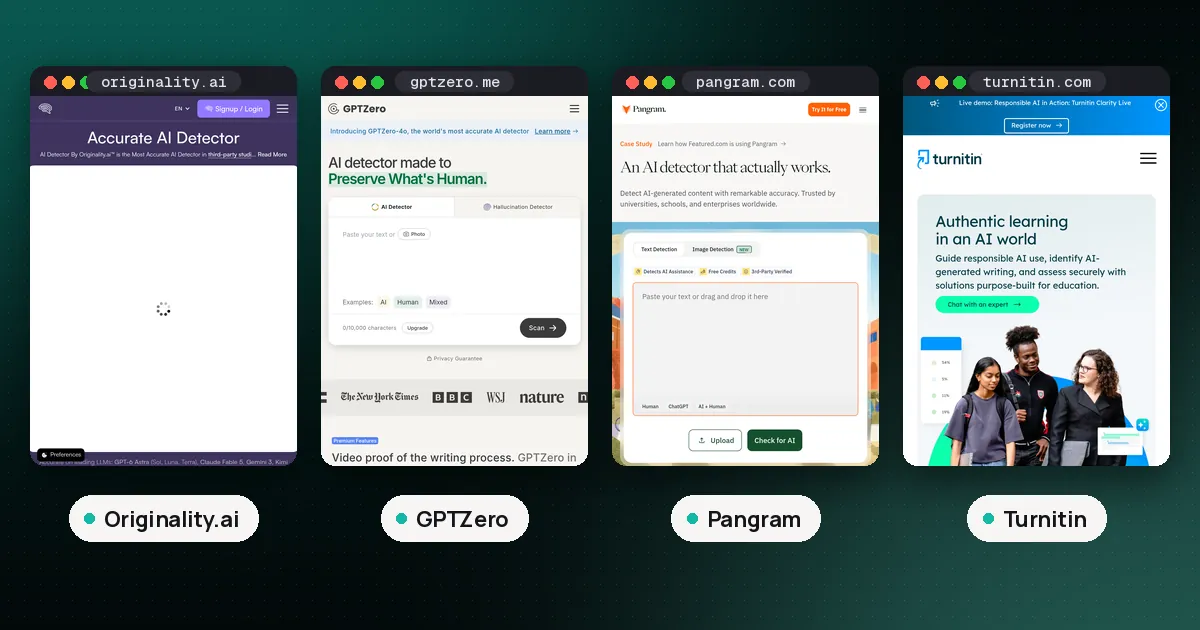
Originality.ai vs GPTZero comes down to who is checking the writing. Originality.ai is built for publishers, agencies and SEO teams that buy content at volume, with AI detection bundled next to plagiarism, readability and fact checking aids. GPTZero is built for classrooms first, with a bigger free monthly allowance, Google Classroom and Canvas hooks, and draft replay for teachers. If a false accusation is your biggest worry, the one public test that ran both tools on the same texts favors GPTZero: it flagged none of 495 human passages, while Originality.ai flagged 19.
That test used versions pinned in June 2026, and both companies have shipped updates since. So read the evidence below as a strong hint, not a permanent ranking. The rest of this guide covers access and prices, what each score means, the independent numbers, and a simple way to pick.
Originality.ai vs GPTZero at a glance
| Item | Originality.ai | GPTZero |
|---|---|---|
| Main audience | Publishers, agencies, SEO teams, freelance editors | Teachers, students, schools, also editors and recruiters |
| Free path | Free scans up to 100 credits per account (1 credit is 100 words); no account needed to try a scan | Free plan up to 10,000 words a month, no credit card |
| Entry paid plan | Pro: 14.95 dollars a month, or 12.95 dollars a month billed annually, 200,000 words a month | Premium: 12.99 dollars a month billed annually, 300,000 words a month |
| Higher plan | Enterprise: 179 dollars a month, or 136.58 dollars a month billed annually, 1.5 million words, API access | Professional: 24.99 dollars a month billed annually, bulk uploads of 250 files, LMS integration |
| Bundled checks | AI, plagiarism, readability, grammar, content quality, fact and hallucination aid | AI, plagiarism, hallucination detector, writing feedback |
| Draft evidence | Writing replay in the browser extension | Writing Replay for Google Docs |
| API | Enterprise plan | API with ready code in 17 languages |
| Current model note | Turbo 3.0.2 was the model Epoch AI tested in June 2026 | GPTZero 4o, default since September 20, 2026 |
Sources for the table: Originality.ai pricing, Originality.ai FAQ, GPTZero pricing explained and GPTZero 4o. Prices were checked on October 22, 2026 and change often, so confirm on the live pages before you buy.
Who each tool is for
Originality.ai: editorial teams that pay per word
Originality.ai sells to people who commission writing. Its own customer quotes come from site owners and SEO consultants checking freelancer drafts. The product works on credits, where one credit covers 100 words. Pro includes 2,000 credits (200,000 words) a month. Enterprise includes 15,000 credits (1.5 million words) a month, extra team seats and API access. One time credits bought on the pay as you go option expire two years after purchase.
The bundle is the real draw. One scan can return an AI score, a plagiarism match, readability and grammar notes, and a fact checking aid that flags claims worth verifying. A content manager who already runs those checks separately gets them in one report, with shareable links for writers.
GPTZero: classrooms and individual writers
GPTZero is the detector many teachers already know. Its pricing page says it is used by over 10 million teachers and students and names it the official AI detector partner of the American Federation of Teachers. The free plan gives 10,000 words a month without a card. On the homepage you can paste text right away, but scans over 10,000 characters need a free account first.
Paid plans add Advanced AI Scan, downloadable reports, bulk file uploads and page by page scanning for long documents. The Professional plan adds LMS integration. GPTZero also offers a Chrome extension, a Google Docs addon and Classroom integration, which is where most teachers meet it. GPTZero is now part of Superhuman, the company that also owns Grammarly (Superhuman announcement).
Free limits compared
For a light user, the free tiers decide the question.
GPTZero's free plan is the more generous of the two: 10,000 words every month, and the allowance renews. That covers roughly twenty 500 word essays a month for a teacher who only checks the papers that worry them.
Originality.ai's free path has changed in 2026. The homepage FAQ now says free scans are limited to 100 credits per account, which is 10,000 words, and the pricing card describes this as a one time allowance rather than a monthly one. The comparison table further down the same pricing page still lists "60 (3 scans/day)" for the free tier, so the two pages disagree. Treat Originality.ai's free option as a trial batch, and check the live page before you rely on it. Our walkthrough of how to use Originality.ai for free covers the free scanner step by step.
One privacy point matters for both. Originality.ai's FAQ says text pasted into the free detector may be used for training, and that account holders can opt out. Never paste confidential client work or student records into any anonymous free box.
How the scores differ
Originality.ai's score
Originality.ai reports the probability that a text is AI or original. A score of 70 percent original does not mean 30 percent of the words were written by AI. It means the model is 70 percent confident the text is human. That is the most common misreading of the tool.
The vendor's own FAQ lists two known causes of false positives: tools that use AI to rewrite or edit copy (it names some Grammarly features) and short texts. Originality.ai returns a clean AI or original verdict at the document level, with no separate "mixed" label.
GPTZero's score
GPTZero gives a document level classification with sentence highlights, and can return a mixed verdict when it judges a text to be part human and part AI. GPTZero 4o, the default model since September 20, 2026, focuses on paraphrased and mixed text. In Advanced Scan it also names stylistic patterns it sees, such as ideas grouped in neat sets of three. GPTZero says the model is punctuation neutral, so adding or removing dashes or semicolons should not decide a result.
GPTZero reports one false positive across 10,402 student essays in the PERSUADE dataset and recall from 99.04 to 99.89 percent on its own test sets of text from GPT-5.6, Gemini 3.6, Grok 4.5 and Claude 5 (GPTZero 4o post). Those are vendor measurements. Originality.ai's homepage, for its part, calls its detector the most accurate in third party studies. Both claims are marketing until a neutral lab checks them.
What the Epoch AI test found
The most useful public evidence for this pairing is a July 15, 2026 data insight from Epoch AI, which ran Pangram, GPTZero and Originality.ai on the same passages (Epoch AI; data and code on GitHub).
The setup was careful. The human set had 495 passages of about 500 words from 99 well known authors, all published before ChatGPT, split evenly across blogs, fiction and scientific writing. The AI set had 594 passages from Claude Opus 4.8, GPT-5.5 and Gemini 3.1 Pro: half from a plain prompt, and half where the model saw five real passages from an author and imitated that style. Epoch tested GPTZero model 2026-05-11-base and Originality.ai Turbo 3.0.2 at default settings.
| Test | GPTZero | Originality.ai |
|---|---|---|
| Human passages wrongly flagged as AI | 0 of 495 (0%) | 19 of 495 (3.84%) |
| Human fiction wrongly flagged | 0 of 165 | 16 of 165 (about 10%) |
| Plain prompt AI missed | 2 of 297 (0.67%) | 1 of 297 (0.34%) |
| Style imitation AI missed | 32 of 297 (10.77%) | 53 of 297 (17.85%) |
| Hardest genre (style imitation) | Scientific, 24% missed | Scientific, 29% missed |
Here is what that means in practice. On plainly prompted AI text, both tools caught nearly everything. The gap opens in two places. First, Originality.ai flagged human writing that predates ChatGPT, and most of those errors landed on fiction. Second, when the AI imitated a real author, Originality.ai missed about one passage in six, against about one in nine for GPTZero.
Epoch also notes limits. GPTZero sometimes returned "mixed", which Epoch counted as a miss; counting it as a detection would cut GPTZero's imitation miss rate from 10.8 to 8.8 percent. Originality.ai was scored through its web bulk uploader because Pro has no API. Only one evasion method was tested, all passages were about 500 words, and the versions date from June 2026. GPTZero 4o arrived later, and Originality.ai updates its models too.
Other 2026 studies tested each tool separately against Turnitin, not against each other. Our Originality.ai vs Turnitin and GPTZero vs Turnitin guides summarize them. For the broader research picture, see are AI detectors accurate?, and for how public detector scoreboards work, the RAID benchmark guide.
Is Originality.ai better than GPTZero?
For catching false positives on clean human writing, the evidence favors GPTZero. For bundled editorial checks and per word pricing at agency volume, Originality.ai offers more in one report. Neither result settles accuracy on the October 2026 versions, and the right answer depends on what a wrong call costs you.
A teacher who wrongly accuses a student pays a high price for a false positive. GPTZero's zero false positives in the Epoch test, its monthly free words and its classroom tools make it the safer first pick there.
A publisher screening freelance drafts may accept a few false flags in exchange for plagiarism, readability and fact checks in the same report. Originality.ai fits that workflow, provided the editor treats a flag as a reason to ask the writer for drafts, not as proof.
Pros and cons
Originality.ai pros: one report with AI, plagiarism, readability and fact checking aids; credit pricing that scales with word volume; team seats and API on Enterprise; writing replay in the browser extension. Cons: the highest false positive rate of the three tools in Epoch's July 2026 test; the free tier is a small one time batch and the pricing page describes it two ways; no API below Enterprise.
GPTZero pros: 10,000 free words every month; zero false positives on Epoch's human set; sentence highlights, mixed verdicts and named AI patterns; Classroom, Canvas and Google Docs tools; API code in 17 languages. Cons: missed about 11 percent of style imitation AI in the same test; the newest accuracy figures for GPTZero 4o are self reported; LMS integration sits on the Professional plan.
Which should you use?
- Teachers without a school license: start with GPTZero's free plan. If a paper flags, read the highlighted sentences, ask for draft history and talk with the student.
- Students checking their own work: use GPTZero as a mirror. Your school's Turnitin report, if it has one, is what instructors see.
- Publishers and SEO agencies: trial Originality.ai Pro on a batch of drafts you know are human and drafts you know are AI. If it flags too many of your human writers, run a second detector before you act.
- Anyone where a false accusation is costly: run two detectors. Pangram also posted zero false positives in the Epoch test; our Pangram vs GPTZero guide compares those two. For free options side by side, see best free AI detector.
A quick way to test on your own material: pick ten texts you wrote before 2022 and ten you generated with the AI model your writers use most. Run all twenty through both free tiers. Count how many human texts each tool flags. That one number tells you more about your risk than any vendor chart. For background on how detectors work at all, see what is AI detection.
FAQ
Is Originality.ai more accurate than GPTZero?
Not on the best public evidence. In Epoch AI's July 2026 test, GPTZero flagged none of 495 human passages while Originality.ai flagged 19, and GPTZero missed fewer AI passages that imitated real authors. Both caught nearly all plainly prompted AI text. The test used June 2026 versions, so retest on current models.
Is GPTZero free?
Yes. GPTZero's free plan covers up to 10,000 words a month with no credit card. Scans longer than 10,000 characters need a free account, and higher limits start with Premium at 12.99 dollars a month billed annually.
Is Originality.ai free?
Partly. Originality.ai's FAQ says you can run free scans up to 100 credits per account, which is 10,000 words, and you do not need an account to try a scan. There is no ongoing free plan like GPTZero's. Pro starts at 12.95 dollars a month billed annually.
Why does Originality.ai flag my human writing?
Its FAQ names AI editing and rewriting tools, including some Grammarly features, and very short texts as causes of false positives. In Epoch's test most of its false flags hit human fiction. Keep drafts and version history so you can show how you wrote a piece.
Can I use GPTZero or Originality.ai instead of Turnitin?
For personal or editorial checks, yes. For graded coursework, your school decides, and Turnitin's AI score is only visible to instructors at institutions that license it.
Should I trust one AI detection score?
No. Scores differ across tools and change when vendors update models. Read the highlights yourself, compare two detectors when the stakes are high, and prefer draft evidence over a single percentage.