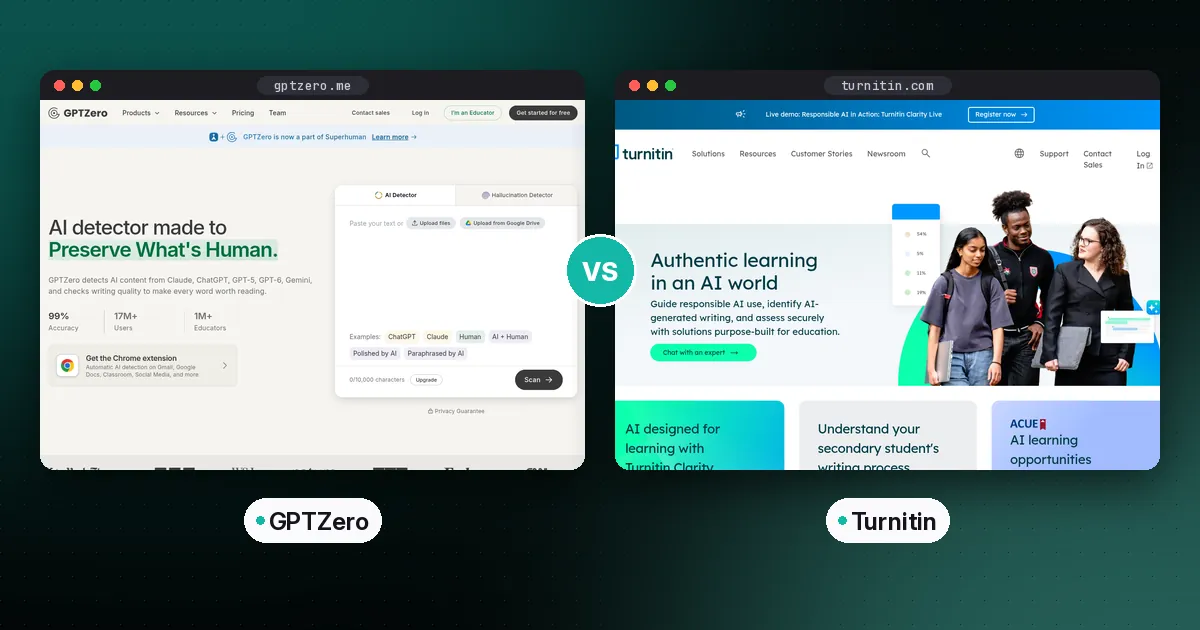
GPTZero vs Turnitin comes down to access first and accuracy second. Turnitin's AI writing detection is an institutional feature that only instructors and administrators can see, while GPTZero is a stand-alone detector anyone can use, with a free plan of 10,000 words a month. On accuracy, independent studies of earlier versions found both tools rarely flag fully human writing but both miss a lot of AI text, and neither study tested the versions shipping today.
Both products changed in the last few months. Turnitin consolidated its English detector into a single model in July 2026 and merged its "AI-paraphrased" category into one "AI-generated" label in August. GPTZero made its new GPTZero 4o model the default on September 20, 2026, and its new owner Superhuman said on September 30 that GPTZero is now part of the company. This guide compares the two as they stand in October 2026, using only the vendors' own documentation and published independent research.
GPTZero vs Turnitin at a glance
| Item | GPTZero | Turnitin |
|---|---|---|
| Who can use it | Anyone: students, teachers, writers, teams, developers | Instructors and admins at institutions that license it |
| Can students see the AI score? | Yes, it is their own scan | No, unless an instructor shares the PDF report |
| Free option | Free plan, up to 10,000 words a month | None for individuals |
| Price | Published plans; see the pricing page | No public price list; licensed to institutions |
| Current model | GPTZero 4o, default since September 20, 2026 | Single consolidated English model since July 2026 |
| Languages | English, Spanish, French, German, Portuguese and more | English, Spanish, Japanese, Modern Standard Arabic |
| Humanizer detection | Claimed for paraphrased and mixed text | Yes, for English only |
| How results are shown | Document verdict with sentence highlights | Percentage of qualifying prose; 1 to 19 percent shown only as an asterisk |
| Writing-process evidence | Writing Replay in Google Docs | Turnitin Clarity, a paid add-on |
In plain terms: if you are a student, you will almost never get to run Turnitin yourself, so the practical comparison is between the report your instructor sees and what a tool like GPTZero tells you. If you are an institution, the question is whether Turnitin's built-in indicator is enough or whether you want a second signal.
Access and pricing
Turnitin
Turnitin sells to schools, universities and publishers, not to individuals. AI writing detection is only available to customers who license Turnitin Originality, or iThenticate 2.0 with the AI writing add-on, and an administrator can switch it off for the whole institution. The indicator sits inside the Similarity Report, so it shows up in Canvas, Moodle, Blackboard and other learning platforms that already use Turnitin. Turnitin's own FAQ is explicit that the AI indicator and report are not visible to students, although instructors can download the report as a PDF and share it (Turnitin AI writing FAQ). There is no public price list; institutions arrange licensing with Turnitin directly.
GPTZero
GPTZero is self-serve. The free plan covers up to 10,000 words a month and includes the Chrome extension, and paid tiers, team seats and an enterprise plan are listed on the GPTZero pricing page. Beyond the web app it offers a Chrome extension, a Google Docs add-on, integrations with Google Classroom, Canvas and Zapier, and a developer API. That makes it the tool individual teachers, students checking their own drafts, editors and recruiters actually reach for.
How each detector works and what the score means
Turnitin's AI writing indicator
Turnitin splits a submission into overlapping segments, scores each segment between 0 and 1 for the likelihood that it is AI-generated, and pools those scores into sentence scores and a document percentage. A few rules matter when you read the result:
- Only prose counts. Bullet points, lists, tables and code are ignored, so the percentage is a share of qualifying prose, not of the whole file.
- Minimum length. An English submission needs at least 300 words of long-form prose and no more than 30,000 words.
- Low scores are hidden. To limit false positives, anything from 1 to 19 percent appears only as an asterisk, with no highlights.
- Conservative by design. Turnitin says it aims to keep the document-level false positive rate below 1 percent for documents with more than 20 percent AI writing, and accepts missing some AI text to do so. Its own example: a document flagged as 50 percent AI could contain as much as 65 percent.
- Humanizers. For English, the model also looks for AI text altered by paraphrasing or "bypasser" tools. Since August 4, 2026 those cases are folded into a single "AI-generated" category instead of a separate purple highlight (Turnitin release notes).
Turnitin says it validates each model update against more than 700,000 academic papers written before ChatGPT existed, and that the indicator should never be the sole basis for action.
GPTZero 4o
GPTZero gives a document-level verdict with sentence highlighting. GPTZero 4o, announced on September 24, 2026, is trained on more academic and social media writing and is designed to hold up when AI text is paraphrased or mixed with human writing (GPTZero 4o announcement). Three changes affect how you read a result:
- AI Patterns. In Advanced Scan, GPTZero now names recurring stylistic patterns it sees in a document, such as ideas arranged in neat sets of three, and explains them.
- Masked Detection. Headings are excluded from the analysis and shown in gray, so changing a title should not swing the score.
- Punctuation-neutral. GPTZero says adding or removing em dashes or semicolons should not decide the result.
The headline vendor claims are one false positive across 10,402 student essays in the PERSUADE dataset, and over 99 percent recall on its own benchmark of text from four frontier model families. These are GPTZero's own measurements, not independent tests.
Which is more accurate?
There is no independent head-to-head of GPTZero 4o against Turnitin's July 2026 model yet. What exists are two credible 2026 studies of earlier versions.
The Springer study. A peer-reviewed study published on June 29, 2026 tested GPTZero, Turnitin, Pangram and Copyleaks on 160 academic papers with known authorship; the AI text was generated in May 2025 (International Journal for Educational Integrity). Its findings for these two tools:
- Human papers: every tool scored all 40 fully human papers in the lowest band, though GPTZero showed a small false positive tendency and Turnitin showed none.
- Fully AI papers: Turnitin put all 40 in its lowest band; GPTZero put 70 percent there and the rest just above it. Both badly underestimated AI content written with ChatGPT's Deep Research mode.
- Mixed papers: Turnitin landed in the correct range for 60 percent of human papers with AI-written sections, and 50 percent after those sections were "humanized." GPTZero got none of the mixed papers and one humanized paper right.
Pangram, not either of these two, was the clear winner in that study.
The Epoch AI test. In July 2026, Epoch AI tested GPTZero (a May 2026 model) against Pangram and Originality.ai on 495 human passages and 594 AI passages from Claude Opus 4.8, GPT-5.5 and Gemini 3.1 Pro (Epoch AI). GPTZero flagged none of the human passages, missed only 2 of 297 plainly prompted AI passages, but missed 32 of 297, about 11 percent, when the models imitated a real author's style. Turnitin was not part of that test.
So what does that mean? On the evidence available, both tools are now unlikely to accuse a writer of fully human, unedited prose. Turnitin did better on mixed human and AI papers in the one study that tested both, and GPTZero has since shipped a model it says fixes exactly that weakness. Until someone tests the current versions side by side, treat any claim that one is simply "more accurate" with caution, including the vendors' own.
Models covered
Turnitin's English FAQ, updated September 21, 2026, lists the models it was built to detect, running from GPT-4o through GPT-5.4, Gemini 3.1 Pro preview, Claude Sonnet 4.6 and Opus 4.5, Grok 4.1 and several open models, plus "tools based on these LLMs." GPTZero's 4o post reports results on text from GPT-5.6, Claude 5, Gemini 3.6 and Grok 4.5. Neither list proves a tool will catch a model released next month. Detectors are retrained continuously, and Turnitin notes a document's score only changes if it is resubmitted.
Writing-process evidence
Both companies now argue that how a document was written matters more than a single score. Turnitin Clarity, a paid add-on launched in July 2025, gives students a writing space and gives instructors a playback of the draft history, pasted text and typing patterns. GPTZero's Writing Replay does the same for documents written in Google Docs. Superhuman, which also owns Grammarly, said GPTZero's detection, hallucination checking, plagiarism checking and writing replay will come to its Superhuman Go assistant alongside Grammarly's Authorship tool (Superhuman).
If you are a writer worried about a false flag, process evidence is your strongest defense with either tool: version history, drafts and notes. Our guide to whether AI detectors are accurate has a step-by-step list of what to do if you are flagged.
Pros and cons
GPTZero pros: anyone can use it; free monthly allowance; sentence highlights and named AI patterns; API and integrations; supports several European languages. Cons: independent studies of earlier models found it underestimated AI content in mixed and humanized papers; its newest accuracy figures are self-reported.
Turnitin pros: built into the plagiarism workflow most universities already use; conservative thresholds; English humanizer detection; large pre-ChatGPT validation set. Cons: no access for individuals; students cannot see their own score; hides scores below 20 percent; missed every fully AI paper in the 2026 Springer study.
Which should you use?
- Students: you cannot choose Turnitin; your institution does. Use GPTZero or another detector only to understand how your writing might read, and keep your drafts.
- Individual teachers without a Turnitin license: GPTZero's free plan and Google Classroom or Canvas integration are the practical option. Treat its result as a reason to talk with the student, not a verdict.
- Universities already on Turnitin: the built-in indicator is the default. Consider a second detector such as Pangram, which led the 2026 Springer study, for disputed cases.
- Publishers, editors and SEO teams: neither is built mainly for you; compare GPTZero with Originality.ai, and test on your own samples first.
Detecting AI text is one slice of a wider problem. For images, audio and video, see our guide to deepfake detection, and for checking whether a model's answers are grounded in fact, see LLM hallucination detection.
FAQ
Is GPTZero as accurate as Turnitin?
There is no clear winner. In the only 2026 peer-reviewed study that tested both, each correctly cleared fully human papers, both missed most fully AI papers, and Turnitin did better on mixed and humanized papers. GPTZero released a new model, GPTZero 4o, in September 2026 that has not yet been tested against Turnitin independently.
Can students check their work with Turnitin's AI detector?
Generally no. Turnitin's AI writing indicator and report are visible only to instructors and administrators at institutions that license it. An instructor can download the AI report as a PDF and share it with a student.
Does Turnitin use GPTZero?
No. Turnitin uses its own transformer-based model trained on its academic writing corpus. GPTZero is a separate company, now part of Superhuman, the owner of Grammarly.
Is GPTZero free?
GPTZero has a free plan that covers up to 10,000 words a month and includes its Chrome extension. Higher limits, advanced scans and team features require a paid plan.
Will Grammarly get my essay flagged by Turnitin?
Turnitin says that, in its tests, ordinary spelling, grammar and punctuation fixes from Grammarly were usually not flagged. Text produced by Grammarly's generative features, such as drafting or paraphrasing, will likely be flagged as AI-generated.
Why does Turnitin show an asterisk instead of a score?
An asterisk means Turnitin found some AI-like text but the score fell between 1 and 19 percent. Because false positives are more likely at low levels, Turnitin shows no number and no highlights in that range.