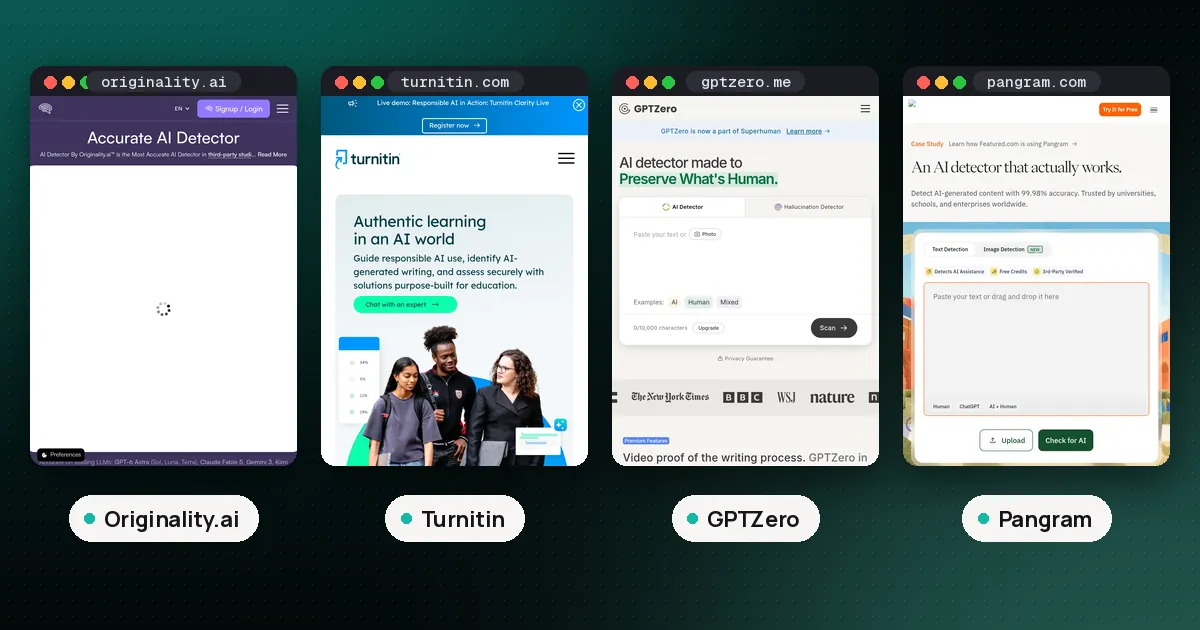
Originality.ai vs Turnitin is mostly a question of who you are, not which logo looks better on a marketing page. Originality.ai is a self serve AI and plagiarism checker aimed at publishers, agencies and freelancers: every account gets 100 free credits once (about 10,000 words), the homepage detector runs without signing up, and paid Pro plans start around 14.95 dollars a month. Turnitin is an institutional integrity platform whose AI writing indicator lives inside the Similarity Report that instructors and admins see: students cannot open it on their own, and there is no public individual price.
Neither tool should be the sole basis for a misconduct decision. A February 2026 peer reviewed study of 192 academic texts found Originality ahead of Turnitin on overall accuracy (0.69 vs 0.61) but both weak on hybrid human and AI writing. An Epoch AI bench on older detector versions found Originality more willing to flag human prose than Pangram or GPTZero. Below is a practical breakdown of access, scoring rules, features and who each product actually fits.
Originality.ai vs Turnitin at a glance
| Item | Originality.ai | Turnitin |
|---|---|---|
| Who can buy or use it | Anyone: publishers, agencies, freelancers, teachers, individuals | Schools, universities and publishers via institutional license |
| Free path | 100 credits one time per account, about 10,000 words (1 credit = 100 words) (pricing) | None for individuals |
| Paid shape | Pro about 14.95 dollars/month (about 12.95 billed annually); Enterprise about 136.58 dollars/month on annual billing (pricing) | No public list price; AI writing requires Turnitin Originality (or iThenticate 2.0 AI addon) |
| Can students see the AI score? | Yes, if they run their own scan | No, unless an instructor shares the PDF |
| Core bundle | AI detection, plagiarism, readability, fact check aids, Chrome/Docs tools | Similarity matching against a large academic corpus plus AI writing indicator |
| Score style | Probability / “Likely Original” vs AI, with adjustable AI Allowance | Percentage of qualifying prose; 1 to 19% shown only as an asterisk |
| LMS workflow | Manual or API (Enterprise); not a default Canvas/Moodle submission gate | Built into Canvas, Moodle, Blackboard and similar via Similarity Report |
| Process evidence | Writer Replay via Chrome / Google Docs extension on paid workflows | Turnitin Clarity (paid addon) for draft playback |
In plain terms: pick Originality.ai when you need a tool you can open today as a publisher or freelancer. Pick Turnitin when your campus already licenses it and you need LMS native similarity plus an instructor only AI indicator. For classroom second opinions that students can run themselves, also compare GPTZero and Pangram.
Who each tool is for
Originality.ai
Originality.ai sells to content teams that commission or publish writing at volume. The homepage AI detector lets you paste or upload text without signing up, but the free allowance is 100 credits per account, used once rather than renewed daily. The pricing page equates that to 10,000 words and lists the free tier with the same feature list as paid plans (Originality.ai FAQ; pricing; walkthrough: how to use Originality.ai for free). Older reviews that promise three free scans a day describe an offer the vendor no longer lists.
Paid Pro is listed at about 14.95 dollars a month on monthly billing, or about 12.95 dollars a month when billed annually. Enterprise is listed around 136.58 dollars a month on annual billing with a large monthly credit allotment (for example 15,000 credits), team seats, longer scan history and API access (pricing). Credits map to word volume (one credit equals 100 words). Paid plans add plagiarism checking, shareable reports, Chrome and Google Docs extensions, and Writer Replay for draft history.
AI Allowance (commonly 0%, 5%, 15%, 25% or 40%) sets how much estimated AI share a team tolerates. That helps hybrid SEO workflows; it is not a Turnitin clone. Vendor blogs that tune Allowance to match Turnitin are calibration hints, not independent science.
Turnitin
Turnitin sells to institutions, not to individuals. You get AI writing detection only through a Turnitin Originality license or iThenticate 2.0 with its AI writing addon, and an admin can switch it off account wide. For a publisher comparing it with Originality.ai, the practical point is placement: the AI percentage is part of the Similarity Report inside the school's LMS, so it reaches instructors, not writers. A student sees it only if an instructor shares the PDF (Turnitin AI writing FAQ).
There is no consumer signup. Pricing is negotiated. Similarity matching (comparing a submission against Turnitin’s corpus of student papers, journals and web content) remains the product’s historic strength; the AI indicator is an overlay on that same report, not a replacement for plagiarism checking. For a student facing alternative many classrooms already discuss, see GPTZero vs Turnitin.
How the scores differ
Turnitin’s AI writing indicator
Turnitin reports a share of qualifying prose (long form sentences), not of the whole file, so lists, bullets, tables and code do not count, and English files need 300 to 30,000 words of such prose. Scores from 1 to 19 percent show only as an asterisk with no highlights. Our how Turnitin detects AI guide walks through the segment and sentence scoring step by step. Turnitin states it aims to keep the document level false positive rate under 1 percent for documents with more than 20 percent AI writing, and that the percentage must not be the sole basis for disciplinary action (FAQ).
As of late 2026 the English model covers a long list of frontier chat models and, for English only, AI paraphraser / “humanizer” tools. Supported AI writing languages include English, Spanish, Japanese, Arabic, and (since October 6, 2026) Turkish, German and Dutch (product updates). A July 2026 architecture update consolidated the English ensemble into a single model while keeping the under 1 percent false positive target.
Originality.ai’s AI Checker and AI Allowance
Originality.ai describes its AI Checker as a modified BERT style classifier that returns probabilistic “original” versus AI scores (FAQ). The pricing page lists plagiarism, readability and fact checking aids on every tier, so paid plans mainly add volume, scan history, team tools and (on Enterprise) API access. AI Allowance shifts the decision threshold: a team that allows 40 percent AI will mark fewer hybrid drafts as over limit than a team set to 0 percent. That flexibility helps publishers with disclosed AI use; it also means two editors can get different pass/fail calls on the same document if their Allowance settings differ.
Free detector text may be used for training; signed in accounts can opt out of training use per the vendor FAQ. Minimum useful length is about 100 words for website scans (help). Treat every score as a triage signal, not proof of authorship.
What independent studies show
Two public 2026 sources are more useful than vendor win blogs.
Hadra, Cambridge and Mesbah (International Journal for Educational Integrity, February 2026). Researchers evaluated Turnitin and Originality on 192 balanced texts: authentic pre ChatGPT EFL student coursework, professional human writing, AI outputs (GPT-4.1 and Claude 3 Opus) and 50/50 hybrid mixes (open access article). Scores were mapped to Human (0 to 20%), Hybrid (21 to 79%) and AI (≥80%). Originality led on overall accuracy (0.69 vs 0.61) and macro average recall (0.60 vs 0.51). Both struggled on Hybrid texts, and accuracy fell on longer and scientific writing. Turnitin showed no significant EFL-versus-professional gap; Originality showed a borderline trend toward better accuracy on professional writing than on EFL student writing. The authors conclude neither tool is suitable as the sole misconduct basis.
Epoch AI data insight (July 2026). On 495 pre ChatGPT human passages and 594 AI passages from Claude Opus 4.8, GPT-5.5 and Gemini 3.1 Pro, Originality.ai (Turbo 3.0.2) posted a 3.84 percent false positive rate on human text (19 of 495), while Pangram and GPTZero posted 0 percent. On plainly prompted AI, all three rarely missed. On style imitated AI, Originality missed about 17.9 percent versus about 10 to 11 percent for Pangram and GPTZero (Epoch AI). Those versions predate some 2026 product updates; treat the ranking as a caution about Originality’s false positive risk on clean human prose, not as a live October 2026 leaderboard.
For a wider detector accuracy tour, including Turnitin’s asterisk rule and GPTZero 4o caveats, see Are AI detectors accurate?. For freemium classroom detectors, see Pangram vs GPTZero.
Features that change day to day use
Access and privacy of the score. Originality.ai is something a freelancer or student can open tonight. Turnitin’s AI indicator is instructor only by design. That single difference decides most real world “vs” searches.
Plagiarism corpus versus AI probability. Turnitin’s Similarity score and AI percentage are independent; the Similarity engine’s value is the corpus match. Originality.ai bundles AI detection with its own plagiarism checker for paid users: useful for publishers, not a substitute for Turnitin’s academic repository when a school already requires Turnitin submission.
LMS automation. Turnitin wins for automatic assignment intake. Originality.ai wins for ad hoc editorial pipelines and API automation on Enterprise.
Process evidence. Both vendors sell draft history products (Writer Replay; Turnitin Clarity). When a false positive would be costly, process evidence beats either percentage alone.
Languages. Turnitin’s AI writing support spans several long form languages as of October 2026, with humanizer detection limited to English. Originality.ai markets broad English first commercial detection; confirm current language coverage on the live product page for your corpus.
Pros and cons
Originality.ai pros: individual signup; 100 free credits to trial; transparent public pricing; AI Allowance for hybrid policies; plagiarism plus editorial extras on paid plans; shareable reports and API on higher tiers. Cons: higher false positive risk than some peers in the Epoch bench on older versions; free allowance is one time, not monthly; not embedded in most campus LMS gates; vendor “similar to Turnitin” blogs are not independent validation.
Turnitin pros: LMS native workflow; large similarity corpus; instructor only AI indicator that students cannot self serve around; explicit under 1 percent false positive target for higher AI bands; multilanguage AI writing expansion through 2026. Cons: no individual access or public price; students cannot preview the AI score before submission; independent work shows weaker catch rates on some fully AI and hybrid sets; asterisks hide low scores that still deserve a human read of the draft.
Which should you use?
- Publishers, SEO teams and agencies: start with Originality.ai. Use the 100 free credits to trial, then Pro or Enterprise if you need plagiarism, history and team seats. Keep AI Allowance documented so freelancers know the house rule.
- Schools and universities that already license Turnitin: stay on Turnitin for submission gates. Add Originality.ai or GPTZero only as a documented second opinion for borderline cases, not as a student workaround.
- Individual teachers without an LMS license: Originality.ai’s free tier or GPTZero/Pangram freemium plans are the practical options; Turnitin is unavailable.
- Students checking a draft: run a free Originality.ai scan or another freemium detector as a mirror, keep version history, and never treat a high AI score as proof you “cheated” or a low score as clearance. Your institution’s Turnitin report is what graders see.
- Disputed academic cases: collect process evidence, run a second detector, and read the highlighted spans. Our accuracy guide outlines what to do if you are flagged.
AI text detection is only one integrity signal. For watermark checks on partner content, see SynthID Detector. Writers publishing on Substack can follow how to use Pangram on Substack.
FAQ
Is Originality.ai like Turnitin?
Partly. Both estimate how much of a document looks AI written and both warn against using a score alone. Turnitin is an institutional LMS product with a huge similarity corpus and an instructor only AI indicator. Originality.ai is a self serve publisher tool with a one time free allowance, public pricing and adjustable AI Allowance. They are complementary more often than interchangeable.
Can students use Turnitin to check AI before submitting?
No, not on their own. The AI percentage is an instructor view inside the Similarity Report, and a student sees it only if the instructor shares the PDF. A writer who wants a check before submitting usually spends Originality.ai's free credits or uses GPTZero or Pangram, and keeps draft history as the stronger defense.
Is Originality.ai free?
Only up to a limit. The vendor's FAQ says you can use it free "with a limit of 100 credits per account", and the pricing page lists that as 10,000 words, one time. After that you buy credits or a plan. Details: how to use Originality.ai for free.
Which is more accurate, Originality.ai or Turnitin?
It depends on the study and the writing type. In the February 2026 IJEI evaluation, Originality led on overall accuracy and recall, but both struggled with hybrid texts, and Originality showed a possible fairness concern on EFL writing. Epoch AI’s July 2026 bench found Originality more likely than Pangram or GPTZero to flag clean human prose. No public study has settled a permanent winner for the exact models shipping today.
Can Originality.ai replace Turnitin for schools?
Not as a drop in. Schools buy Turnitin for Similarity matching, LMS integration and policy workflows. Originality.ai can be a second detector or a publisher tool; replacing Turnitin requires institutional procurement and process redesign, not a student subscription.
Should I trust a single AI detection score?
No. In the studies above the two tools disagreed on the same texts, and both slipped on hybrid writing. An Originality.ai score also moves with the AI Allowance a team picks. For a freelancer dispute or a student case, look at the highlighted passages and the draft history before the number.