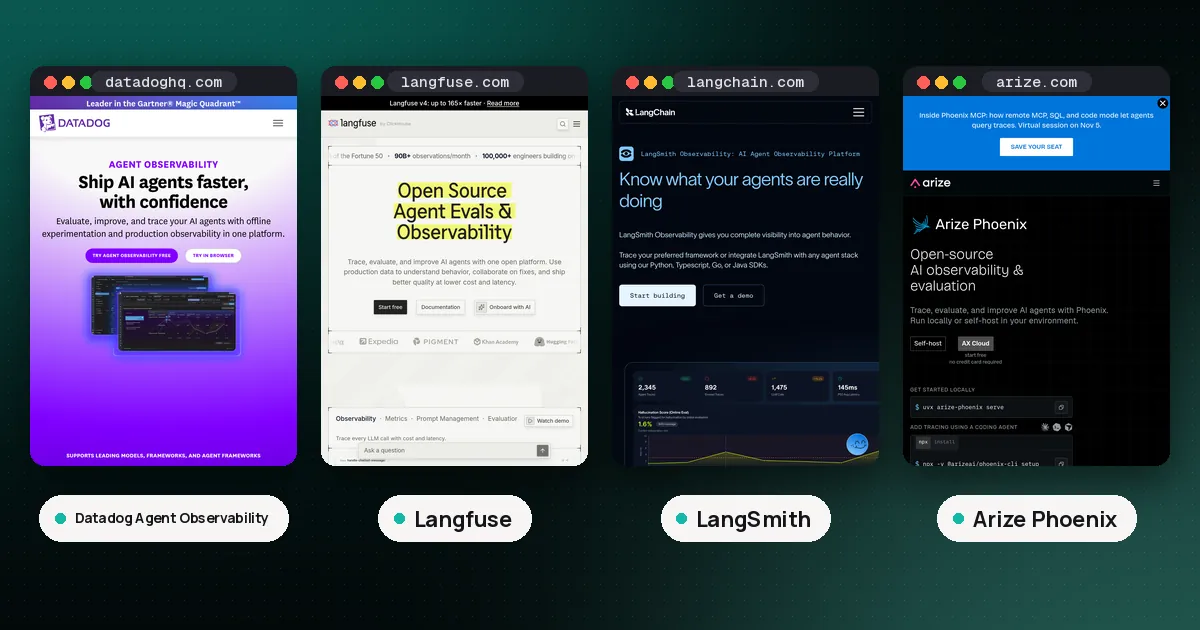
In the Datadog LLM Observability vs Langfuse decision, pick Datadog if your company already runs on Datadog and you want agent traces sitting next to the APM, infrastructure and user session data your on call engineers already watch. Pick Langfuse if you want open source software you can self host for free, longer data access on cheap plans, or a tool that is independent of your monitoring vendor. The biggest practical difference is billing: Datadog charges only for calls to an LLM provider, while Langfuse charges for every trace, step and score you send.
One naming note before we start. Datadog renamed the product to Agent Observability in mid 2026. The docs still live under llm_observability URLs and the SDK still uses LLMObs names, but the product page, price list and docs now use the new name (Datadog Agent Observability). People still search for the old name, so this guide uses both.
Datadog LLM Observability vs Langfuse at a glance
| Item | Datadog (Agent Observability) | Langfuse |
|---|---|---|
| What you pay for | LLM spans (one call to a model provider) | Units: traces plus observations plus scores |
| Free tier | Up to 40,000 LLM spans a month | Hobby: 50,000 units a month, 2 users |
| First paid tier | Pro: 160 dollars a month for 100,000 LLM spans (annual billing) | Core: 29 dollars a month for 100,000 units |
| Default history | 15 days for traces and spans | 30 days (Hobby), 90 days (Core), 3 years (Pro) |
| Self hosting | No, hosted Datadog only | Yes, free under MIT, same stack as the cloud |
| Instrumentation | ddtrace SDK for Python, Node.js and Java, plus OpenTelemetry and an HTTP API | Python and JavaScript SDKs built on OpenTelemetry, plus an OTLP endpoint |
| Best for | Teams already standardized on Datadog | Teams that want openness, data custody or low cost |
Prices are list prices checked on October 23, 2026 from the Datadog price list and Langfuse pricing.
How the two pricing models work
LLM observability pricing at Datadog
Datadog bills on one thing. In its own words, an LLM span is a single call to an LLM provider, and tool, workflow, agent, embedding and retrieval spans are all free. The Free plan covers up to 40,000 LLM spans a month with 15 days of retention. Pro starts at 160 dollars a month and includes 100,000 LLM spans.
The list price for the first 100,000 spans is 160 dollars on annual billing, 200 dollars month to month and 240 dollars on demand. Each extra 10,000 LLM spans at the default 15 day retention costs 3.50 dollars (annual), 4.20 dollars (month to month) or 5 dollars (on demand). Longer retention raises the rate per 10,000 spans. On annual billing it is 5 dollars for 30 days, 6.50 dollars for 60 days and 7.50 dollars for 90 days.
Evaluations have no separate fee. If an evaluation makes LLM calls, those calls count as LLM spans.
Langfuse pricing
Langfuse counts units, where units equal traces plus observations plus scores (billable units docs). An observation is any span, event or generation, so a retrieval step and a tool call each count. Scores created by Langfuse features such as LLM judges, annotation queues and experiments also count.
Hobby is free with 50,000 units and 30 days of data access. Core costs 29 dollars a month with 100,000 units, 90 days of data access and unlimited users. Pro costs 199 dollars a month with 3 years of data access. Usage beyond the included 100,000 units is graduated: 8 dollars per 100,000 units up to 1 million, 7 dollars up to 10 million, 6.50 dollars up to 50 million, then 6 dollars. Self hosting the open source version has no usage bill at all.
Worked cost examples
These are our own calculations from the list prices above. Your span mix will differ, so count your own traffic before you budget.
Example 1: a small RAG chatbot
Say 20,000 questions a month. Each question creates one trace with four steps: an embedding, a retrieval, a query rewrite call and an answer call. That is two LLM calls per question.
- Datadog: 2 times 20,000 is 40,000 LLM spans, which fits inside the Free plan. Cost: 0 dollars, with 15 days of history.
- Langfuse: 1 trace plus 4 observations is 5 units per question, or 100,000 units a month. That is over Hobby's 50,000, so you need Core. Cost: 29 dollars, with 90 days of history and unlimited users.
Example 2: a busy agent
Say 50,000 agent runs a month. Each run has one agent span, six LLM calls, eight tool calls and two retrievals, plus one user feedback score.
- Datadog: only the six LLM calls bill, so 300,000 LLM spans. Pro covers 100,000; the other 200,000 are 20 blocks of 10,000. On annual billing that is 160 plus 20 times 3.50, or 230 dollars a month. On demand it is 240 plus 20 times 5, or 340 dollars.
- Langfuse: 1 trace, 17 observations and 1 score is 19 units per run, or 950,000 units. On Core, 100,000 are included and 850,000 cost 8 dollars per 100,000, which adds 68 dollars. Total: 97 dollars a month.
The pattern is clear. Datadog's model rewards agents with many cheap steps around few model calls, and it is very cheap at low volume. Langfuse's model rewards apps with few steps per request and teams that need months of history, because 90 days on Core costs nothing extra while Datadog charges more per span for longer retention. Langfuse also publishes an editable comparison sheet that claims it is cheaper than Datadog on a representative workload. Treat that as a vendor claim and plug in your own numbers.
Features: tracing, evaluation and prompts
Both products now cover the same core workflow: nested traces of model calls, tools and retrieval with token cost and latency; datasets built from production traces; offline experiments; LLM judges; human review; and prompt management.
Datadog adds two managed evaluators (Language Mismatch and Sensitive Data Scanning), custom LLM judge evaluators written in natural language, end user feedback, annotation queues and external evaluations pushed through its API (evaluations docs). Its real strength is context. The product page says you can correlate LLM spans with APM services, infrastructure signals and real user monitoring sessions, so a slow answer can be traced to a starved database or GPU in the same tool. Sensitive Data Scanner is included and scales with LLM usage.
Langfuse includes datasets, experiments from the SDK or the UI, LLM judge evaluators, custom scores, user feedback and annotation queues on every plan, with queue limits on lower tiers (one on Hobby, three on Core). Prompt versioning, a playground and prompt experiments are included on all plans. Alerts are capped by plan (2 on Hobby, 20 on Core, 50 on Pro). If you are new to judge based scoring, our guide to LLM judges explains how to calibrate it.
Neither tool reports confidence intervals on your eval scores for you, so if you compare two prompts on a small dataset, do the statistics yourself. Our guide on how to evaluate LLM applications covers sample sizes.
Hosting, data custody and compliance
This is often the deciding factor. Langfuse is open source, and its self hosting docs say you run the same infrastructure that powers Langfuse Cloud, with a few addon features behind a license key (self hosting docs). Docker Compose works for a single machine; Kubernetes with Helm is the production route. Langfuse Cloud offers US, EU, Japan and a HIPAA region, and Pro includes SOC 2 and ISO 27001 reports and a BAA. ClickHouse acquired Langfuse in January 2026, as covered in our Langfuse vs LangSmith comparison.
Datadog Agent Observability is only available as part of hosted Datadog. You pick a Datadog site (region), and the docs note the product is not supported on the US government sites. The product page lists HIPAA compliance, role based access control and sensitive data redaction. If your rule is that prompts and outputs must never leave your network, Datadog cannot meet it and self hosted Langfuse can.
Setup and instrumentation
Datadog uses the same ddtrace library as its APM. In Python you install ddtrace, set DD_LLMOBS_ENABLED=1, an app name in DD_LLMOBS_ML_APP and your API key, then start the app with ddtrace-run. Node.js and Java have equivalent setups. The SDK automatically traces common providers and frameworks such as OpenAI, Anthropic, LangChain and Bedrock. Datadog also accepts OpenTelemetry traces that follow the GenAI semantic conventions (version 1.37 or later) or OpenInference, without the Datadog SDK or a Datadog Agent (OpenTelemetry docs).
One recent extra is Lapdog, a free local tool (Lapdog docs) that captures spans, prompts, tool calls and cost from your app or from coding agents such as Claude Code and Codex, and shows them in a browser dashboard with no Datadog account. It is built on the open source Datadog APM test agent and can forward data to Datadog later.
Langfuse offers Python and JavaScript SDKs built on OpenTelemetry, native integrations for most frameworks, and an OTLP endpoint at /api/public/otel for any other language or for an OpenTelemetry Collector (Langfuse OpenTelemetry docs).
Because both accept OpenTelemetry, the cleanest trial is to instrument once with OpenTelemetry (for example with OpenLLMetry) and have a Collector send the same traces to both tools for two weeks. Our AI agent observability guide explains the OpenTelemetry approach in more detail.
Datadog LLM Observability vs LangSmith
The same logic applies if LangSmith is the alternative. LangSmith bills by seat and by trace: the Developer plan is free for one seat with up to 5,000 base traces a month, and Plus costs 39 dollars per seat per month with up to 10,000 base traces, then pay as you go (LangSmith pricing). Self hosting is an Enterprise option. LangSmith fits teams built on LangChain and LangGraph; Datadog fits teams built on Datadog. If neither describes you, Langfuse or Arize Phoenix are the neutral picks, as our Langfuse vs Arize Phoenix and best LLM observability tools guides explain.
Which should you choose?
Choose Datadog when:
- Datadog already monitors your services and your incident process lives there.
- You want one trace from the user session through the backend to the agent's reasoning.
- Your agents make few model calls but many tool and retrieval steps, or your volume fits the free 40,000 spans.
Choose Langfuse when:
- Traces must stay on your own infrastructure, or you want no vendor lock in.
- You need 90 days or more of history without paying per span for it.
- You want a cheap, predictable bill for a small team, or the free self hosted version.
Many teams run both: Datadog for production health and alerting, Langfuse for prompt work and evals. OpenTelemetry makes that a configuration choice rather than a rewrite.
FAQ
Is Datadog LLM Observability free?
Partly. The Free plan includes up to 40,000 LLM spans a month with 15 days of retention and full feature access. Above that you need Pro, which starts at 160 dollars a month for 100,000 LLM spans on annual billing.
What counts as an LLM span in Datadog?
One call to an LLM provider such as OpenAI or Anthropic. Tool, workflow, agent, embedding and retrieval spans are free. One agent run can create several LLM spans, and LLM calls made by evaluations count too.
Is Langfuse cheaper than Datadog?
It depends on your trace shape. In our examples, a small chatbot was free on Datadog but 29 dollars on Langfuse Core, while a busy agent cost about 230 dollars on Datadog (annual billing) against 97 dollars on Langfuse Core. Self hosted Langfuse has no usage fee.
Can I send the same traces to Datadog and Langfuse?
Yes. Both accept OpenTelemetry traces, so an OpenTelemetry Collector can export the same spans to both. Datadog expects the GenAI semantic conventions (1.37 or later) or OpenInference; Langfuse receives OTLP at its /api/public/otel endpoint.
Is Datadog Agent Observability the same as LLM Observability?
Yes. Datadog renamed LLM Observability to Agent Observability in 2026. The pricing and features carried over, and code identifiers such as LLMObs and the llm_observability docs path kept the old name.