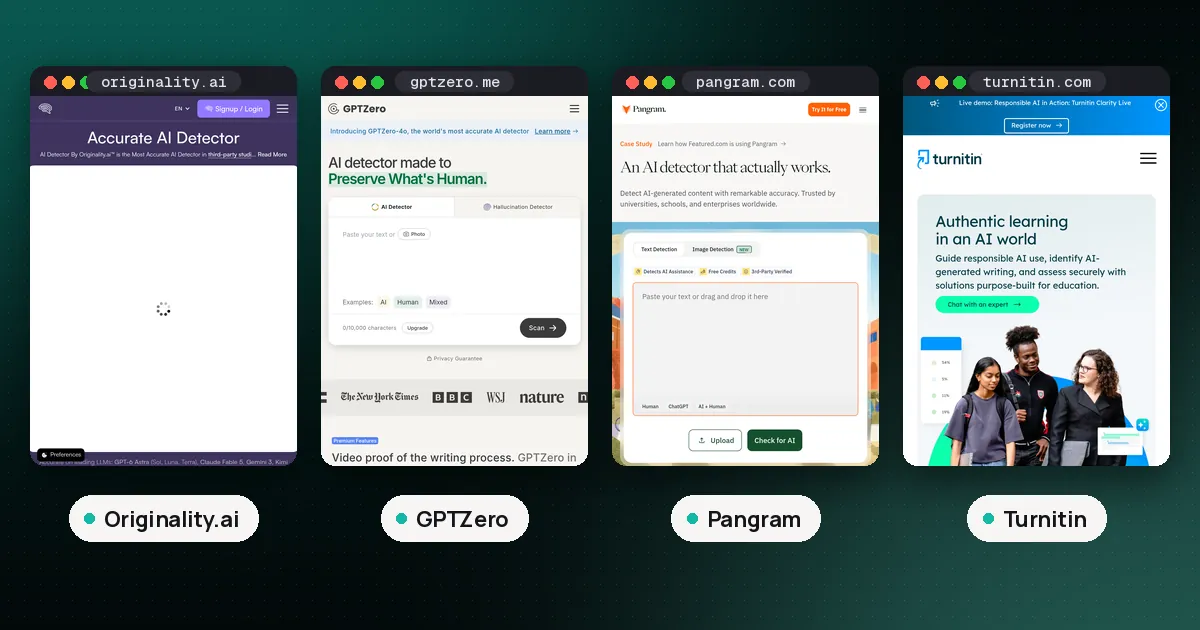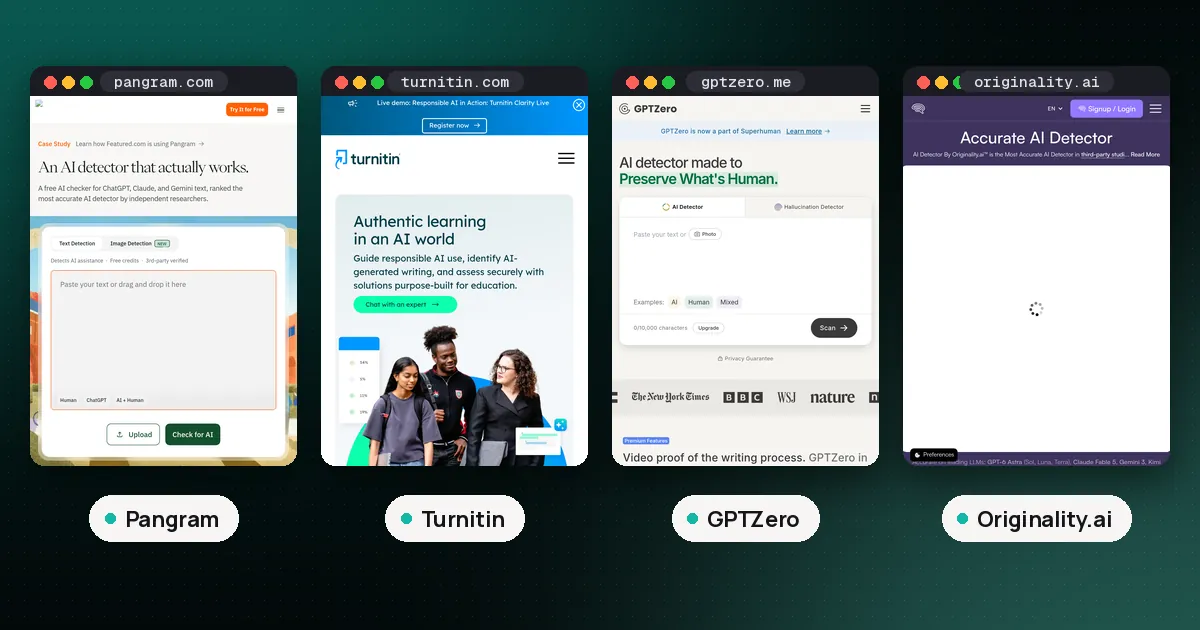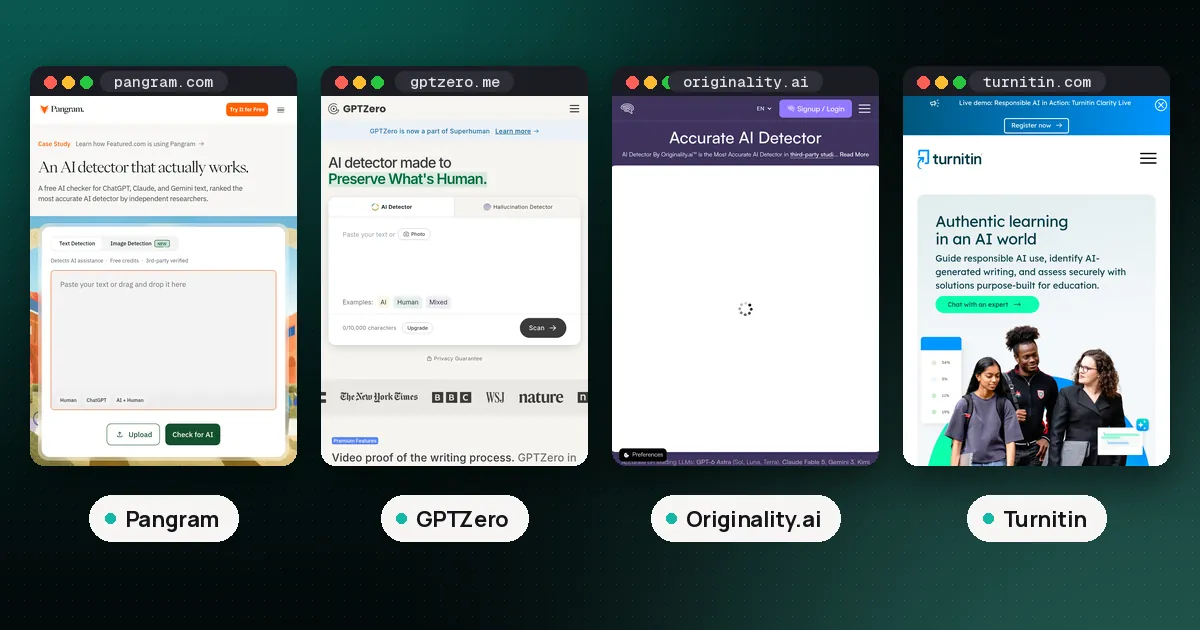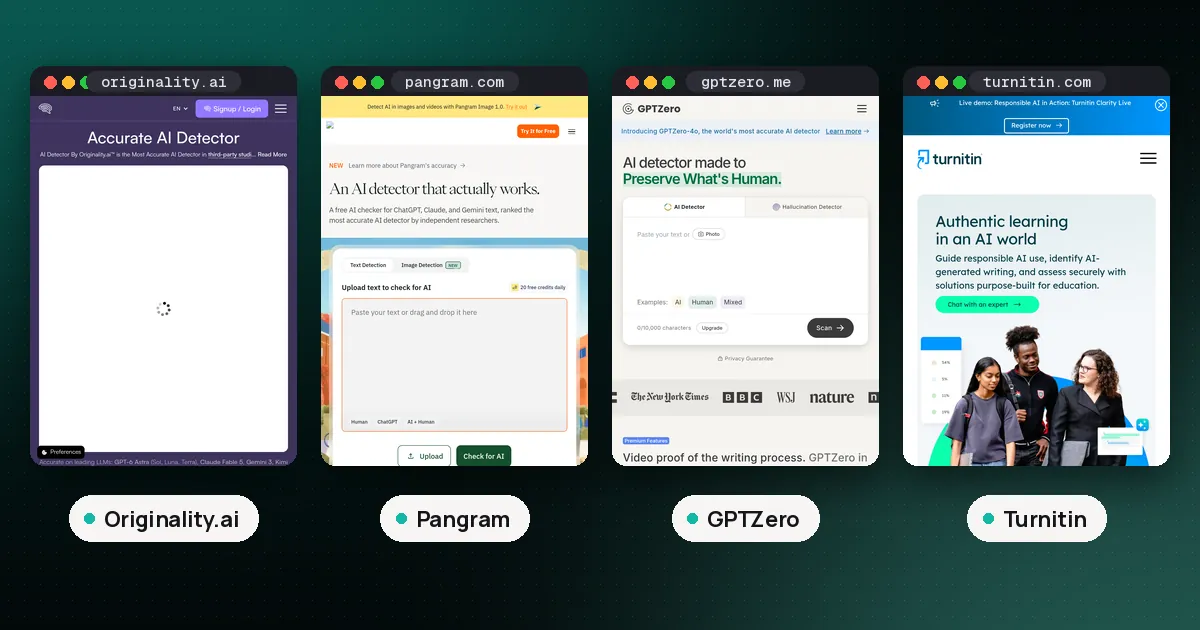
Originality.ai vs Pangram is a choice between a publisher content suite and a detector first freemium product. Originality.ai bundles AI detection with plagiarism, readability, grammar and fact checking aids for agencies and SEO teams that buy writing at volume. Pangram focuses on AI and AI assisted labels, section windows, multilingual text, image scans and a renewing free daily allowance. On the best public head to head that ran both tools on the same texts (Epoch AI, July 2026), Pangram flagged none of 495 human passages while Originality.ai flagged 19, and Pangram also missed fewer style imitated AI passages. That test used June 2026 model builds, so treat it as a strong hint rather than a permanent ranking.
Prices and plan features below were rechecked on the vendors' pricing pages on Nov 5, 2026. We did not run a first hand scan of either product for this guide. Free walkthroughs: how to use Originality.ai for free and how to use Pangram on Substack.
Originality.ai vs Pangram at a glance
| Item | Originality.ai | Pangram |
|---|---|---|
| Main audience | Publishers, agencies, SEO editors, freelance buyers | Educators, publishers, trust and safety, developers |
| Free path | 100 credits once per account (about 10,000 words on the standard model); no ongoing free plan | Up to 2,000 words per day (20 credits), no card; 3 image scans per day |
| Entry paid plan | Pro: 14.95 dollars a month, or 12.95 dollars a month billed annually; 2,000 credits a month | Individual: 20 dollars a month, or 15 dollars a month billed annually; up to 300,000 words a month |
| Higher plan | Enterprise: 179 dollars a month, or 136.58 dollars a month billed annually; 15,000 credits, API | Professional: 65 dollars a month, or 45 dollars a month billed annually; up to 1.5 million words, 200 dollars monthly API usage |
| Score style | Document AI or original probability; AI Allowance settings (0%, 5%, 15%, 25%, 40%) | Document verdict plus section windows with AI, AI assisted and human fractions |
| Bundle beyond AI | Plagiarism, readability, grammar, content quality, fact checking aid | Plagiarism on paid plans; built in AI image scans on free and paid |
| Languages and images | English first editorial workflow | Detection in over 20 languages; image detector included |
| API note | API on Enterprise | Prepaid credits at 0.05 dollars per 100 words (Pangram 4.1); Individual includes 10 dollars monthly API credits, Professional includes 200 dollars |
Sources for the table: Originality.ai pricing, Pangram pricing, Pangram free account help and the Pangram homepage. Confirm live pages before you buy; both vendors change prices and credit rules.
Who each tool is for
Originality.ai: editorial teams that pay per word
Originality.ai sells to people who commission writing. One credit covers 100 words for a standard AI scan. Pro includes 2,000 credits (200,000 words) a month. Enterprise includes 15,000 credits (1.5 million words) a month, longer scan history, team roles and API access. Separately purchased pay as you go credits expire two years after purchase according to the vendor FAQ.
The bundle is the real draw. One scan can return an AI score, a plagiarism match, readability and grammar notes, and a fact checking aid, with shareable links for writers. Originality.ai also ships a Chrome extension with writing replay in Google Docs. For campus framing see Originality.ai vs Turnitin; for the classroom freemium brand see Originality.ai vs GPTZero.
Pangram: careful reviewers who want low false positives
Pangram Labs builds a freemium detector for educators, publishers and moderation teams. The free plan renews every day: 20 credits (up to 2,000 words), AI assistance labels, file upload and OCR, Chrome and Google Docs hooks, detection in over 20 languages, and three image scans. Paid Individual and Professional plans raise monthly word and image limits and add plagiarism on every scan. Professional includes 200 dollars of monthly API usage. Schools can buy an Educational Institution LMS path.
Pangram's pitch is section level evidence, not a single percentage. That helps when a paragraph was lightly edited or co-written. See also Pangram vs GPTZero and Pangram vs Turnitin.
Free limits compared
For light use, the free tiers often decide the question.
Pangram Free renews: up to 2,000 words every day with no card (Pangram free account help, reviewed July 24, 2026). That covers a few papers a day without a subscription.
Originality.ai's free path is a one time batch: 100 credits once per account (about 10,000 words on the standard model). There is no renewing monthly free plan. Credits burn faster on DeepScan and Max. See how to use Originality.ai for free.
One privacy point: Originality.ai's FAQ says text pasted into the anonymous free detector may be used for training, and account holders can opt out. Never paste confidential client or student work into any anonymous free box.
How the scores differ
Originality.ai's score and AI Allowance
Originality.ai reports the probability that a text is AI or original. A score of 70 percent original does not mean 30 percent of the words were written by AI. It means the model is 70 percent confident the text is human. That is the most common misreading of the tool.
In 2026 Originality.ai added AI Allowance settings (0%, 5%, 15%, 25%, 40%) so a publisher can ask whether a draft stays inside a chosen assistance budget. The vendor's October 25, 2026 comparison blog argues this mixed writing path is where Originality.ai flags more hybrid documents than Pangram on the company's internal tests. Those numbers are vendor run. Use them as a product claim, not as independent science.
Pangram's score
Pangram returns a document verdict plus section windows with AI, AI assisted and human fractions. Pangram 4 launched July 29, 2026; Pangram 4.1 followed on October 19, 2026 with more stable predictions under small edits and a class probabilities output (Pangram 4.1 model card). Vendor reported false positive rates on Pangram's own benches are extremely low. Treat them as self reported until a neutral lab retests the shipping build.
What independent tests show
Neither company should be the sole referee of its own accuracy. Three public sources are useful for this pairing.
Epoch AI style corpus (July 15, 2026). Epoch tested Pangram 3.3.2, GPTZero (2026-05-11-base) and Originality.ai Turbo 3.0.2 on 495 pre ChatGPT human passages and 594 AI passages from Claude Opus 4.8, GPT-5.5 and Gemini 3.1 Pro, including style imitation (Epoch AI data insight; GitHub).
| Test | Pangram | Originality.ai |
|---|---|---|
| Human passages wrongly flagged as AI | 0 of 495 (0%) | 19 of 495 (3.84%) |
| Human fiction wrongly flagged | 0 of 165 | 16 of 165 (about 10%) |
| Plain prompt AI missed | 0 of 297 (0%) | 1 of 297 (0.34%) |
| Style imitation AI missed | 30 of 297 (10.10%) | 53 of 297 (17.85%) |
Pangram and GPTZero both showed zero false positives on that human set. Scientific style imitation was the hardest cell for every detector. Epoch pinned June 2026 builds.
Springer peer reviewed study (June 2026). Researchers tested GPTZero, Turnitin, Pangram and Copyleaks on 160 academic papers with known authorship (International Journal for Educational Integrity). All four cleared fully human papers. Pangram detected fully AI papers far better than GPTZero or Turnitin in that snapshot. Originality.ai was not in that set, and the AI samples predate Pangram 4.
University of Chicago Booth / BFI working paper. A policy oriented evaluation argued that Pangram was the only commercial detector in its set that met a stringent false positive policy cap (at or below 0.005) without collapsing AI detection, with Originality.ai and GPTZero as a secondary commercial tier (BFI working paper PDF). It used earlier model versions.
The honest summary: on older pinned versions, Pangram looks stronger on false positives and on style imitated AI in the Epoch table, while Originality.ai's own mixed writing studies claim it flags more hybrid assistance. Until someone publishes a side by side of the November 2026 shipping models on a shared corpus, "which is more accurate" is not a settled fact. For the wider accuracy picture, see are AI detectors accurate.
Features that change day to day use
Originality.ai is an all in one editorial desk: AI, plagiarism, readability, grammar and a fact checking aid together. Pangram is detector first, with plagiarism on paid plans and image detection even on Free (3 scans a day). Pangram advertises detection in over 20 languages; Originality.ai is built around English language editorial text. For images and video beyond Pangram's image tool, see deepfake detection and how to check if a video is AI generated.
Pangram publishes prepaid API credits at 0.05 dollars per 100 words for Pangram 4.1 text, with a 20 percent bulk discount. Originality.ai gates API access behind Enterprise. Pangram also sells an LMS institution plan. Originality.ai is not the campus default; schools that already run Turnitin should start with GPTZero vs Turnitin and how does Turnitin detect AI.
Pros and cons
Originality.ai pros: lower entry paid price than Pangram Individual; bundled editorial checks; AI Allowance; Chrome writing replay; Enterprise API. Cons: free path is one time; Epoch's pinned test showed higher false positives on human fiction and more misses on style imitation; API sits on Enterprise only.
Pangram pros: renewing free daily allowance; zero false positives on Epoch's human set for the pinned build; section level AI assisted labels; multilingual and image detection; LMS path. Cons: entry paid Individual costs more than Originality.ai Pro; newest accuracy numbers are still largely vendor reported; less known as a full SEO content suite.
Which should you use?
- Publishers and SEO agencies that want one desk for AI, plagiarism and readability: start with Originality.ai Pro on known human and known AI drafts. If it flags too many human writers, run Pangram as a second opinion before you act.
- Teachers, editors or moderators who care most about not accusing clean human prose: start with Pangram Free. The daily allowance renews, and the independent false positive evidence on older builds is the stronger of the two.
- Anyone checking hybrid or lightly edited drafts: try both. Originality.ai's AI Allowance encodes a policy threshold; Pangram's section fractions show where assistance sits. Neither score alone is a verdict.
- Anyone where a false accusation is costly: run two detectors and prefer draft evidence over a single percentage. See also best free AI detector and what is AI detection.
A quick self test: pick ten texts you wrote before 2022 and ten you generated with the model your writers use most. Run all twenty through both free tiers. Count how many human texts each tool flags. That number tells you more about your risk than any vendor chart.
FAQ
Is Pangram more accurate than Originality.ai?
On the best public head to head that included both (Epoch AI, July 2026), Pangram had fewer false positives on human text and fewer misses on style imitated AI than Originality.ai Turbo 3.0.2. Both caught nearly all plainly prompted AI. The test used June 2026 builds, and Originality.ai's later mixed writing studies claim an advantage on hybrid drafts. Retest on current models with your own documents.
Is Originality.ai free?
Partly. Originality.ai offers 100 free credits once per account (about 10,000 words on the standard model). There is no renewing free plan. Pro starts at 14.95 dollars a month, or 12.95 dollars a month billed annually.
Is Pangram free?
Yes for light use. Pangram Free covers up to 2,000 words per day with no card, plus a few image scans. Paid Individual starts at 20 dollars a month (15 dollars billed annually). Plan by plan detail: is Pangram Labs free.
Why does Originality.ai flag my human writing?
Its FAQ names AI editing and rewriting tools and very short texts as causes of false positives. In Epoch's test most of its false flags hit human fiction. Keep drafts and version history so you can show how you wrote a piece. For wider accuracy context, see are AI detectors accurate.
Can I use Originality.ai or Pangram instead of Turnitin?
For personal or editorial checks, yes. For graded coursework, your school decides. Compare campus tools in Pangram vs Turnitin and Originality.ai vs Turnitin.
Should I trust one AI detection score?
No. Scores differ across tools and change when vendors update models. Read the highlights yourself, compare two detectors when the stakes are high, and prefer draft evidence over a single percentage. For a free shortlist, see best free AI detector.