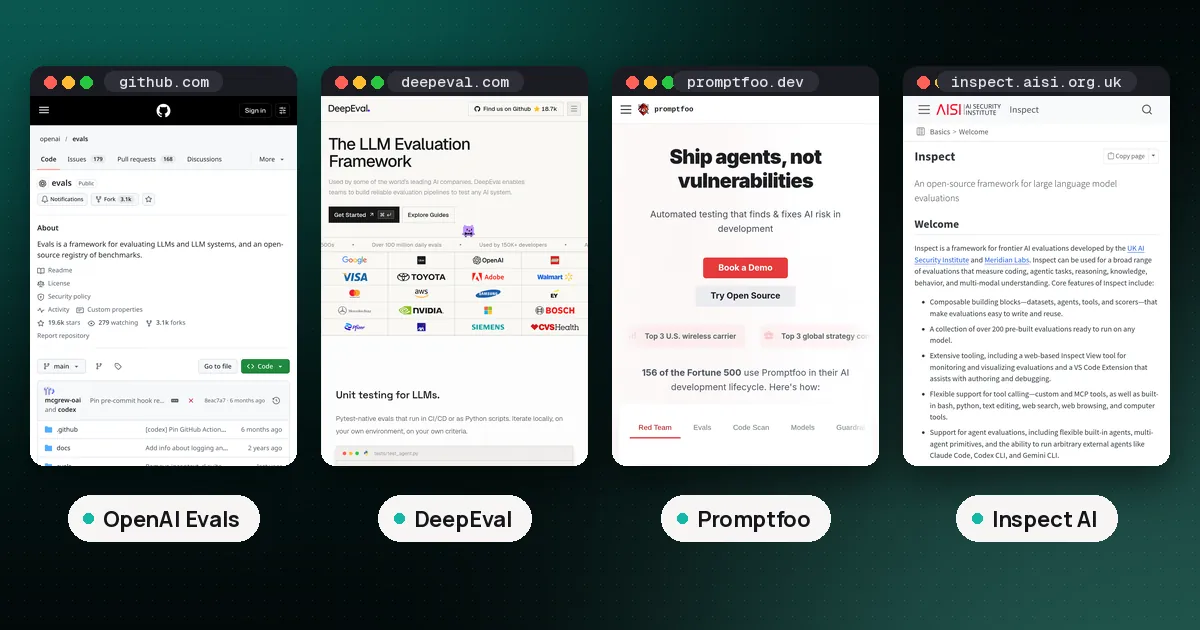
In the OpenAI Evals vs DeepEval choice in October 2026, pick DeepEval if you want an Apache 2.0, pytest style library you run in CI against any model provider. Treat OpenAI Evals as a short lived Platform product: OpenAI says existing evals become read only on October 31, 2026 and the platform shuts down on November 30, 2026, and it points migrating teams to Promptfoo. If you still need OpenAI's hosted graders this month, use them only for short experiments, then move the suite out before the cutover.
That deprecation is the main reason this comparison matters now. The two products never solved the same job the same way: OpenAI Evals lived in the OpenAI dashboard and API; DeepEval lives in your repo as unit tests. Below is a practical breakdown of workflow, metrics, CI, cost shape, and when a third option is the better exit.
OpenAI Evals vs DeepEval at a glance
| Item | OpenAI Evals (Platform) | DeepEval |
|---|---|---|
| What it is | Hosted evals product (dashboard + Evals API) | Open source Python (and TypeScript) eval framework |
| License / ownership | Proprietary OpenAI product | Apache 2.0 (GitHub) |
| Where evals live | OpenAI Platform project | Your git repo (test_*.py / Vitest) |
| Run style | Create eval → upload data → create run via API or UI | deepeval test run with assert_test() |
| Model scope | Tied to OpenAI's Platform workflow | Any provider you configure for generation and judging |
| Hosted reports | Built into the dashboard | Optional via Confident AI (deepeval login) |
| Status in late 2026 | Read only Oct 31; shutdown Nov 30, 2026 | Actively maintained open source framework |
| OpenAI's stated migration path | Export / recreate in Promptfoo | Not OpenAI's official path (still a strong CI alternative) |
In short: OpenAI Evals wins only if you need a few more weeks of dashboard graders inside an existing OpenAI project. DeepEval wins if you want durable, code reviewed evals that fail a pull request the same way unit tests do.
What "OpenAI Evals" actually means
Searchers say "OpenAI Evals" for two related things, and the difference matters.
- OpenAI Evals Platform (dashboard + API). This is the product OpenAI documents under Working with evals: you define a
data_source_configandtesting_criteria(string checks, model graders, similarity graders, and related types), upload JSONL datasets, create runs against a prompt and model, then inspect a report URL in the dashboard. That is what most "how to use OpenAI Evals" tutorials mean in 2025 to 2026. - The older open source registry at github.com/openai/evals, which our OpenAI Evals tool page still lists. It is a framework plus a registry of eval definitions. Separately, OpenAI's simple-evals repo stopped tracking new models in July 2025 and mainly hosts reference implementations.
When people compare OpenAI Evals vs DeepEval, they almost always mean the Platform product versus DeepEval's library. The rest of this guide uses that meaning, and calls out the open source registry only when it helps.
How to use OpenAI Evals (while it still runs)
OpenAI's guide frames three steps: describe the task as an eval, run it on test inputs, then analyze and iterate. Programmatically that looks like:
evals.createwith a JSON schema for each dataset row and one or more graders intesting_criteria.- Upload a JSONL file with
purpose: "evals". evals.runs.createwith a Responses (or Chat Completions) prompt template that fills{{ item.* }}fields.- Poll the run or watch webhooks (
eval.run.succeeded/ failed / canceled), then open thereport_url.
That flow is convenient when your prompts already live in the OpenAI Platform and you want graders without standing up infrastructure. It is a weak long term home for an application test suite: the definitions sit outside your application repo, runs are asynchronous Platform jobs, and after November 30, 2026 the product itself is gone. OpenAI's own cookbook now walks teams through moving from OpenAI Evals to Promptfoo.
How DeepEval works instead
DeepEval treats an LLM interaction as a test case. In Python you build an LLMTestCase (input, actual output, optional expected output and retrieval context), attach metrics, and call assert_test(). You run the file with deepeval test run, not plain pytest, so DeepEval can handle async metrics, caching and reporting (quickstart).
Metrics score from 0 to 1 against a threshold that defaults to 0.5, and most ship a human readable reason. Built ins cover answer relevancy, faithfulness, contextual precision/recall, hallucination, G-Eval rubrics, agent task completion, and more (metrics intro). For RAG specific stacks you can also pair DeepEval with Ragas; see our RAG evaluation metrics guide.
DeepEval also instruments agents (LangChain, LangGraph, CrewAI, OpenAI Agents, and others), scores full trajectories, and can attach component metrics to individual spans. Optional Confident AI login stores shared reports and regression views; the library itself still runs locally without it.
OpenAI Evals alternatives: who should pick what
Choose DeepEval when:
- Your team already writes Python (or TypeScript/Vitest) tests and wants evals in the same pull request gate.
- You call multiple providers, local models, or non OpenAI judges.
- You need RAG, agent trajectory or custom G-Eval metrics with pass/fail thresholds.
- You want Apache 2.0 code you can pin, fork and review.
Stay on OpenAI Evals only when:
- You already have Platform datasets and runs you must finish before October 31, 2026.
- You need a few more dashboard experiments this month and will migrate immediately after.
Prefer Promptfoo when:
- You want OpenAI's documented migration path, YAML configs beside the app, and strong CLI/CI plus red teaming.
- Your stack is TypeScript heavy or you already use Promptfoo for prompt regression.
Also consider:
- Inspect AI for rigorous, research style agent evaluations.
- Braintrust if you want a hosted eval platform with an open scoring library.
- Our roundup of best LLM evaluation frameworks and the playbook on how to evaluate LLM applications if you are still choosing a primary stack.
OpenAI Evals vs LangSmith (and other related phrases)
"OpenAI Evals vs LangSmith" shows up next to this query, but it is a different comparison. LangSmith is an observability and experiment platform from LangChain (tracing, datasets, evaluators, deployments). OpenAI Evals is a grader/run product for prompts and models inside OpenAI's Platform. If your question is really about tracing LangChain apps, start with Langfuse vs LangSmith and our LLM observability tools guide, then add DeepEval or Promptfoo as the CI assertion layer on top of traces.
Migration checklist before November 30, 2026
- Export or recreate every Platform eval you still rely on: prompts, dataset rows, and grader logic.
- Pick a durable home: Promptfoo if you want OpenAI's cookbook path; DeepEval if you want pytest shaped Python tests.
- Revalidate LLM-as-a-judge graders against human labels; similarity and judge scores rarely match 1:1 across systems (OpenAI's migration guide warns about this).
- Wire the new suite into CI so a failing metric blocks merge the way a unit test would.
- Keep a short freeze window after cutover where you run both old reports (read only after October 31) and the new suite side by side.
Pros and cons
OpenAI Evals pros: polished dashboard, native API, tight fit if you already live in the OpenAI Platform, low setup for a first grader.
OpenAI Evals cons: shutting down November 30, 2026; OpenAI centric workflow; eval definitions and history leave with the product unless you migrate.
DeepEval pros: Apache 2.0, pytest style CI, large metric library, multiprovider and agent tracing, optional hosted reports without locking core evals to one vendor.
DeepEval cons: you maintain the suite and judge model keys yourself; hosted Confident AI features are a separate product decision; OpenAI will not hand you an official DeepEval export.
FAQ
Is OpenAI Evals shutting down?
Yes. OpenAI's evals documentation states that existing content becomes read only for existing users on October 31, 2026, and the platform is scheduled to shut down on November 30, 2026. Check OpenAI's deprecations page for the latest dates.
What are the best OpenAI Evals alternatives?
For a code first CI suite, DeepEval and Promptfoo are the most direct replacements. Promptfoo is OpenAI's documented migration recommendation. DeepEval is the better fit for pytest style Python teams. Inspect AI, Ragas (for RAG), and Braintrust cover adjacent needs; Inspect AI vs DeepEval compares the first of those with DeepEval directly.
How do I use OpenAI Evals while it still works?
Create an eval with a data schema and testing criteria, upload JSONL test data, create a run with your prompt template, then review the dashboard report. Prefer that path only for short term experiments you will recreate elsewhere before shutdown.
Does DeepEval work only with OpenAI models?
No. DeepEval evaluates the outputs you pass in, and you can configure various providers (and local models) for both generation and LLM-as-a-judge metrics. OpenAI is a common default in quickstarts, not a hard requirement.
OpenAI Evals framework or DeepEval for RAG apps?
DeepEval. It ships faithfulness and contextual metrics designed for retrieval pipelines, and it pairs cleanly with Ragas. OpenAI Evals can grade RAG answers with custom criteria, but it does not give you a portable RAG metric library that survives the Platform shutdown.
Should I migrate to Promptfoo or DeepEval?
Migrate to Promptfoo if you want the path OpenAI documents and a YAML/CLI workflow. Migrate to DeepEval if your team thinks in pytest and wants rich Python metrics plus agent trajectory scoring. Either is better than staying on a product with a November 2026 end date.