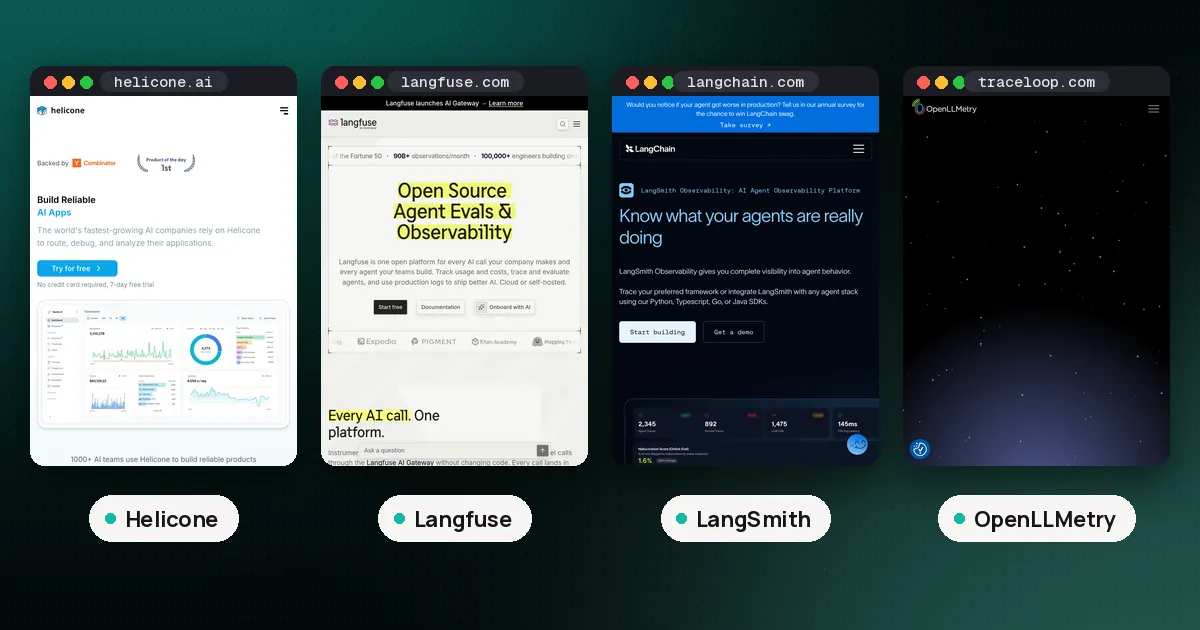
Helicone vs Langfuse comes down to direction of travel in late 2026. Helicone is a proxy first request logger and AI gateway that has run in maintenance mode since Mintlify acquired it in March 2026, and on November 12 its site added a notice that it is now part of Experiential Labs. Langfuse is an MIT licensed tracing, prompt management and evaluation platform that ships releases several times a week and just added its own gateway. For a new project, pick Langfuse. Keep Helicone only if you already run it and depend on its caching, fallbacks or credits billing, and plan your exit on your own schedule.
The two tools started from opposite ends. Helicone began as a URL you swap into your OpenAI client so every call gets logged with cost and latency. Langfuse began as an SDK that records nested traces of an agent or pipeline and then lets you score them. In 2026 they overlap more than ever, so this guide compares them on what you actually get today: capture method, gateway features, evals, pricing, self hosting and the ownership situation. Everything here was checked against official pages on November 12, 2026.
Helicone vs Langfuse at a glance
| Item | Helicone | Langfuse |
|---|---|---|
| Main approach | Proxy and AI gateway; async logging also possible | SDK and OpenTelemetry tracing; gateway in beta |
| License | Apache 2.0 | MIT core, separate enterprise folders |
| Owner and status | Mintlify since March 2026, maintenance mode; site now says part of Experiential Labs | ClickHouse since January 2026, active development |
| Free cloud tier | 10,000 requests a month, 1 GB storage, 7 days of data, 1 seat | 50,000 units a month, 30 days of data, 2 users |
| First paid plan | Pro, 79 dollars a month plus usage | Core, 29 dollars a month, 100,000 units |
| Runs evaluations | No, stores scores you send | Yes, LLM as a judge, datasets, experiments |
| Gateway caching and fallbacks | Yes | Not yet (beta limitation) |
| Self host | All in one Docker image, Helm | Docker Compose, Helm, Terraform |
Read the table this way: Helicone is still stronger at the gateway jobs (caching, fallbacks, one bill for many providers), while Langfuse is far stronger at everything that happens after a call is logged.
Where Helicone stands after two ownership changes
Mintlify announced on March 3, 2026 that it was acquiring Helicone. The founders joined Mintlify, and the announcement said Helicone would keep operating in maintenance mode, with security updates, bug fixes and new models still shipping, and that Mintlify would work with every customer on a migration to another platform. That last line is the important one. A vendor that offers to help you leave is telling you where the product is headed.
On November 12, 2026, the banner on helicone.ai changed to "Helicone is now part of Experiential Labs. Details to come soon." The matching GitHub commit from that morning adds the public notice and a subscription redemption message inside the signed in app. Experiential Labs describes itself on its own site as a Y Combinator backed AI gateway company. No terms, roadmap or pricing changes had been published when we checked, so treat any claim about what happens next as a guess until Helicone posts the details.
The repository tells a consistent story. It has about 6,300 GitHub stars and is not archived, but the last tagged release is from August 2025, and recent commits are mostly security fixes synced from a private repository plus hosting fixes. One October commit stops provider keys from being returned in plaintext over the API, which is the sort of patch you want, and also the sort of work a maintenance team does.
None of this means Helicone stops working tomorrow. Our test requests on November 12 reached both its AI Gateway and its older OpenAI proxy, and both answered normally for an invalid key. It means you should not start a new multiyear dependency on it without knowing who owns it next month.
How each tool captures LLM calls
Helicone offers two routes, compared on its proxy versus async page. The proxy route is the famous one: change the base URL, add a Helicone key, and every request flows through Helicone's edge on its way to the provider. The newer AI Gateway at ai-gateway.helicone.ai takes OpenAI format requests for 100+ models and translates them for Anthropic, Google and others. The async route logs calls after the fact, for example through OpenLLMetry, so Helicone is off your critical path, but you lose the bucket cache, retries and custom rate limits.
For agents, Helicone groups related calls into sessions using three request headers: a session ID, a path such as /abstract/outline, and a name. That gives you a tree, but you build it by setting headers on each call.
Langfuse captures through its Python and TypeScript SDKs, framework integrations and OpenTelemetry, so a trace holds every nested step: model calls, retrieval, tool calls and your own functions. If you already use OpenTelemetry, our OpenLLMetry vs Langfuse guide shows how the two fit together. Since November 9, Langfuse also has a proxy route, the Langfuse AI Gateway, which records each call that passes through it as a generation, nested under your existing trace when you pass a trace header.
The practical difference: Helicone sees requests, Langfuse sees programs. If your app is a single prompt per user action, request logs are enough. If it is an agent with ten steps and a retriever, you want the trace view.
Gateway features: the one area Helicone still leads
Helicone's gateway has had years to mature. Its caching stores full responses in Cloudflare Workers KV, keyed on the URL, body and relevant headers, and you turn it on with one header. It supports automatic provider fallbacks, custom rate limits, and a credits model where Helicone holds the provider keys and charges what it describes as 0% markup, so you get one bill instead of five provider accounts. You can also bring your own keys.
The Langfuse gateway is a public beta and says so. Its known limitations page lists no retries, no fallbacks and no caching, and spend caps are on the roadmap rather than shipped. Provider coverage is growing fast: on November 12 Langfuse added Microsoft Azure (Foundry) and Google AI Studio to a list that already had OpenAI, Anthropic, Amazon Bedrock, OpenRouter, xAI and Vercel AI Gateway. It calls providers with your own keys, so there is no credits option.
If response caching or failover is a hard requirement, two honest options exist: keep Helicone for now, or put a dedicated gateway in front of your models and send traces to Langfuse.
Evaluation and prompt management
This is where the comparison stops being close. Helicone's own scores documentation says plainly that Helicone does not run evaluations and is not an evaluation framework. You run Ragas or your own checks elsewhere and post the numbers back. It does have datasets, a playground and prompt management that can deploy prompt versions through the gateway.
Langfuse treats evaluation as a core feature. It runs LLM as a judge evaluators on live traces, manages datasets, runs experiments from the SDK or the UI and charts how each score moves across runs, and it has annotation queues for human review. Prompt management includes versioning, release labels, composable prompts and caching on the client. If evals matter to you, our explainer on LLM as a judge covers how those judge scores work and where they go wrong.
Helicone pricing vs Langfuse pricing
Helicone pricing, from its pricing page on November 12:
- Hobby: free, 10,000 requests a month, 1 GB storage, 1 seat, 7 days of data, ingestion limited to 10 logs a minute.
- Pro: 79 dollars a month plus usage based charges, unlimited seats, alerts, reports and HQL queries, 1 month of data.
- Team: 799 dollars a month plus usage, 5 organizations, SOC 2 and HIPAA, 3 months of data.
- Enterprise: custom, with on premises deployment and SAML SSO.
Pro and Team have a 7 day free trial. Model costs are separate: you pay providers directly, or buy Helicone credits.
Langfuse pricing, from its pricing page the same day, is based on units, where a unit is any trace, observation or score you send:
- Hobby: free, 50,000 units a month, 30 days of data, 2 users.
- Core: 29 dollars a month, 100,000 units, 8 dollars per extra 100,000, 90 days of data, unlimited users.
- Pro: 199 dollars a month, 3 years of data, higher rate limits, SOC 2 and ISO 27001 reports. A Teams addon for SSO and finer access control is 300 dollars a month.
- Enterprise: 2,499 dollars a month.
Comparing the two is not one to one, because Helicone counts requests and Langfuse counts every span. A plain gateway call in Langfuse records one generation, so 10,000 calls fit inside the free Hobby plan with room to spare. An agent trace with eight nested steps and two scores is about eleven units, so the same 50,000 units cover far fewer agent runs. For small teams, Langfuse Core at 29 dollars with unlimited users is much cheaper than Helicone Pro at 79 dollars plus usage. For licensing detail on the free tier, see is Langfuse free for commercial use.
Self hosting each one
Both are open source and both can be self hosted for free, apart from your infrastructure. Helicone publishes an all in one Docker image, helicone/helicone-all-in-one, that bundles the dashboard, its Jawn API, PostgreSQL, ClickHouse and MinIO storage. Note one recent change in those docs: Jawn no longer proxies LLM traffic, so to proxy requests on your own servers you now run the separate AI Gateway next to it.
Langfuse runs the same architecture as its cloud: web and worker containers plus PostgreSQL, ClickHouse, Redis or Valkey and S3 compatible storage, deployable with Docker Compose, Helm or Terraform (self hosting docs). It is heavier to operate, but it is the setup Langfuse itself runs in production, and ClickHouse, which owns Langfuse since January 2026, is also the database underneath it.
How to move from Helicone to Langfuse
If you are on Helicone today, a calm migration looks like this:
- List what you use. Check whether you rely on caching, fallbacks, credits billing or rate limits. Those have no Langfuse equivalent yet and need a plan of their own.
- Start dual logging. Add Langfuse tracing (the SDK, OpenTelemetry or the Langfuse gateway) on one service while Helicone keeps running. Compare costs and token counts for a week.
- Map your headers. Helicone session IDs and custom properties map naturally to Langfuse sessions, user IDs and metadata. Set them in code rather than in headers.
- Export history you need. Helicone keeps 7 days on Hobby and 1 month on Pro, so export anything you want for datasets or audits before you cancel.
- Move evals last. Rebuild your scores as Langfuse evaluators or SDK scores, then switch off the Helicone base URL.
If you would rather stay hosted and closed, our Langfuse vs LangSmith comparison and the wider LLM observability tools roundup cover the other main options. For the hosted route specifically, Helicone vs LangSmith compares request billing with trace billing and the two gateways.
Which should you pick?
- New project, any size: Langfuse. It is actively developed, the free tier is larger, the paid entry point is cheaper and evaluation is built in.
- Existing Helicone user who depends on caching or fallbacks: stay for now, start dual logging, and decide once Experiential Labs publishes its plans.
- You only want a gateway with one bill across providers: Helicone's credits model still does that today, but ownership risk makes it a short term choice.
- You need traces of multistep agents: Langfuse, because its trace tree comes from your code rather than from headers you set by hand.
FAQ
Is Helicone shutting down?
No shutdown has been announced. Mintlify said in March 2026 that Helicone would run in maintenance mode with security fixes, bug fixes and new models, and on November 12, 2026 the site added that Helicone is now part of Experiential Labs, with details to come. Both of its endpoints answered our test requests that day.
What is the best Helicone alternative?
For observability and evals, Langfuse is the closest open source replacement and is actively developed. If you mainly used Helicone as a gateway for caching and fallbacks, you may need a dedicated gateway as well, since the Langfuse gateway does not offer those yet.
Is Helicone cheaper than Langfuse?
At the free tier it depends on your traffic shape: Helicone gives 10,000 requests, Langfuse gives 50,000 units where every span counts. On paid plans Langfuse is cheaper to start, at 29 dollars a month against Helicone Pro at 79 dollars plus usage.
Does Langfuse have a gateway like Helicone?
Yes, since November 9, 2026, in public beta. The Langfuse AI Gateway records each call as a traced generation, but it has no retries, fallbacks or caching yet and uses your own provider keys.
Can I use Helicone and Langfuse together?
Yes. Many teams run both during a migration: Helicone stays in the request path for caching while the Langfuse SDK records full traces. Just expect each call to be counted on both bills.
Are Helicone and Langfuse open source?
Yes. Helicone is under the Apache 2.0 license. Langfuse's core is MIT licensed, with a small set of enterprise features in separate folders that need a license key.