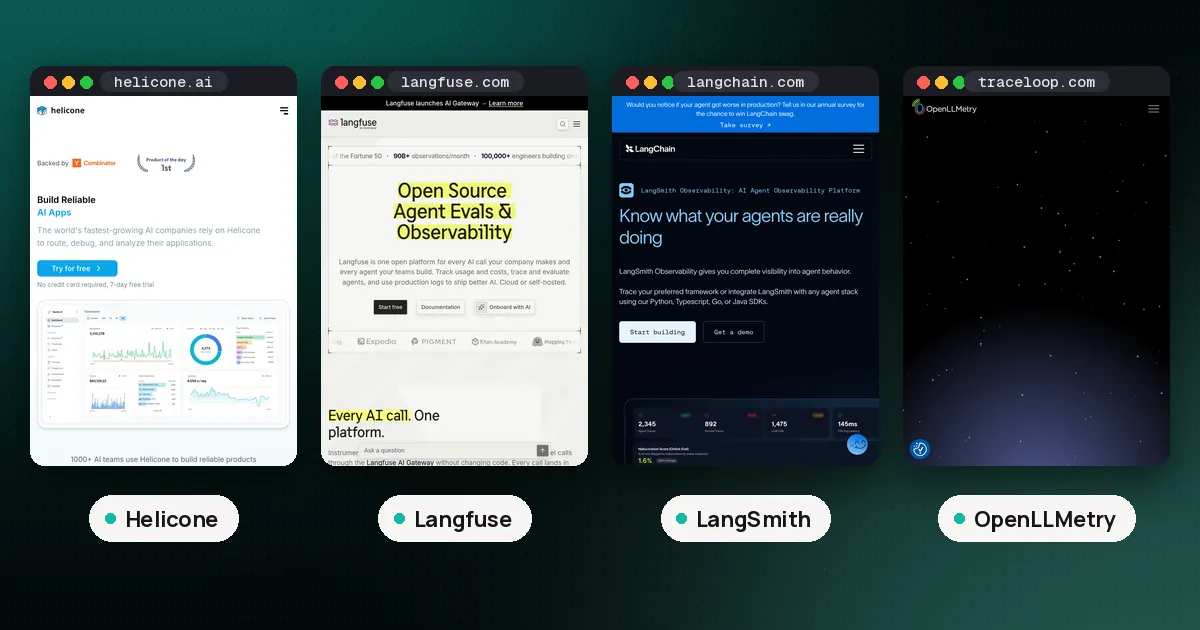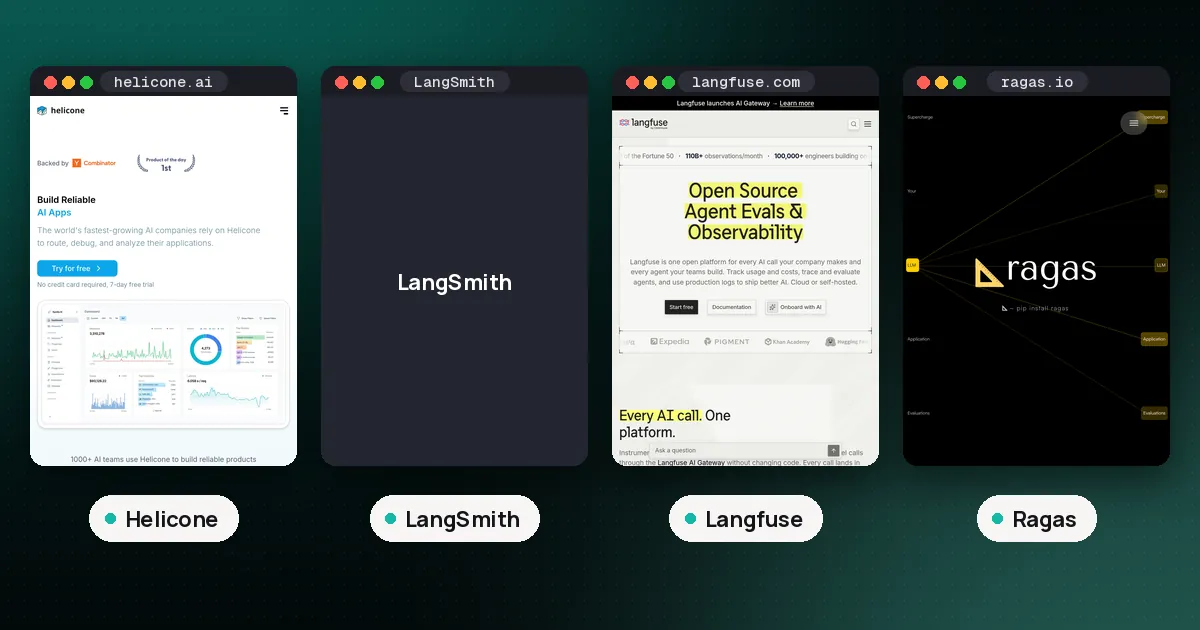
Helicone vs LangSmith is a choice between counting model requests and understanding whole agent runs. Helicone logs every call that passes through its proxy or AI Gateway, with strong response caching and fallbacks, but it has been in maintenance mode since March 2026 and changed owners again on November 12. LangSmith records full traces of your app, runs evaluations and, since July 2026, has its own LLM Gateway in public beta. For a new project, especially one built on LangChain or LangGraph, pick LangSmith. Keep Helicone only for what it still does better: response caching, a free self hosted option and one bill across providers.
The two products are often compared because both promise "one line" setup, but they sit in different places. Helicone sits between your code and the model provider and sees HTTP requests. LangSmith sits inside your code through an SDK and sees the program: every model call, tool call and retrieval step, nested under one run. That difference decides what you can debug, what you can evaluate and, less obviously, what you pay for. Everything below was checked against official pages and docs on November 14, 2026.
Helicone vs LangSmith at a glance
| Item | Helicone | LangSmith |
|---|---|---|
| How it captures data | Proxy or AI Gateway; async logging also possible | SDK tracing (@traceable, wrappers, LangChain callbacks); gateway in beta |
| What a free plan counts | 10,000 requests a month | 5,000 base traces a month, 1 seat |
| First paid plan | Pro, 79 dollars a month plus usage, unlimited seats | Plus, 39 dollars per seat a month, 10,000 base traces |
| Runs evaluations | No, it stores scores you send | Yes, offline and online evals, datasets, annotation queues |
| Response caching | Yes, full responses at the edge | No; passes through provider prompt caching only |
| Fallbacks and spend limits | Fallbacks and custom rate limits | Fallbacks, spend and rate policies (beta) |
| License and self hosting | Apache 2.0, free to self host | Proprietary platform; self hosting is an Enterprise add on |
| Status | Maintenance mode; now part of Experiential Labs | Actively developed by LangChain |
The billing unit decides more than the sticker price
This is the part most comparisons skip. Helicone's pricing page counts requests: the free Hobby plan includes 10,000 requests, 1 GB of storage, one seat and seven days of data. LangSmith's pricing page counts traces, and its own FAQ defines a trace as one execution of your application, which can include many model calls and other steps.
To see what that means in practice, we traced a small agent with the LangSmith Python SDK. Each run made three model calls plus a tool step and a retriever step. Three runs produced 18 runs in the trace tree but only 3 traces, which is what LangSmith bills. Through Helicone, the same three runs would be 9 requests, because each model call is one request, and the tool and retriever steps would not appear at all unless you logged them separately.
Scale that up and the free tiers look different from the headline numbers:
- Helicone Hobby: 10,000 requests divided by three model calls per run is about 3,333 agent runs a month.
- LangSmith Developer: 5,000 traces is 5,000 agent runs, whether each run makes three model calls or thirty.
The pattern flips for simple apps. If each user action is one model call, Helicone's 10,000 requests beat LangSmith's 5,000 traces. So count model calls per user action before you compare plans. The more steps your agent takes, the better LangSmith's unit looks.
What each tool can actually see
Helicone sees the request and response for each model call, plus cost, latency, tokens and any custom properties you attach as headers. To group the calls of one agent run, you add session headers (Helicone-Session-Id, Helicone-Session-Path and a name) to every call, which builds a path tree such as /request/validation. Tool calls and vector database queries can be logged too, but through a separate logger SDK rather than the proxy.
LangSmith sees whatever your code marks as a run. In our test the agent function, each model call, the tool and the retriever all appeared as separate runs with parent and child links, and the SDK sent them in one batched upload rather than one network call per step. With LangChain or LangGraph, tracing is automatic once two environment variables are set; our guide on using LangSmith with LangGraph walks through node level traces, threads and trajectory evals.
There is one tradeoff in Helicone's favor. Because the proxy sees the raw HTTP call, it works from any language and any framework without an SDK. LangSmith's SDKs cover Python and TypeScript, and other languages need the REST API or OpenTelemetry.
Gateways: Helicone's lead has narrowed
For two years the gateway was Helicone's clearest advantage. Its AI Gateway takes OpenAI format requests for 100+ models, falls back between providers automatically and offers credits that it describes as 0% markup, so you can skip separate provider accounts. Its caching stores complete responses in Cloudflare Workers KV, keyed on the URL, body and relevant headers, so a repeated request during testing costs nothing. The proxy vs async page is clear that caching and custom rate limits only work on the proxy route.
LangSmith answered with its own LLM Gateway. LangChain announced it in private beta on May 13, 2026 and opened a public beta on July 30. It accepts OpenAI Chat Completions, OpenAI Responses and Anthropic Messages requests at gateway.smith.langchain.com and translates between formats when the model's provider uses a different API. Its controls are aimed at governance:
- Fallbacks: one to five backup models per chain, triggered by status codes such as 408, 429, 500 and 503, with a 120 second wait for first output per attempt by default (fallback docs).
- Spend policies: caps per organization, workspace, user or API key over hourly, daily, weekly or monthly windows. A blocked call gets a 402 response. The spend policy docs warn that the call that crosses the cap still succeeds, and calls sent close together can overshoot it.
- Data protection: PII and secrets redaction, which the gateway product page lists as an Enterprise feature.
What it does not have is Helicone style response caching. The API formats page only covers passing through each provider's own prompt caching, which cuts input token cost but still calls the model.
A useful billing detail: gateway traces store metadata only by default (token counts, policy outcomes, caller) and the traces docs say those are not billed against your trace quota. If you turn on content logging, a request counts once no matter how many fallback attempts it took.
Plan access is not fully settled. The product page says the gateway is included with Plus and Enterprise during the beta and that Gateway Credits (hosted inference powered by Fireworks) are sold on Developer and Plus, while the credits doc says credits are on paid plans other than Enterprise. Check inside your own account before you plan around it.
Evaluations and prompts
Helicone is direct about this in its scores docs: it does not run evaluations and is not an evaluation framework. You run Ragas, LangSmith or your own checks elsewhere and post the numbers back. It does offer datasets, a playground and prompt management through the gateway.
LangSmith's pricing page lists online and offline evals, dataset collection, annotation queues for human feedback, a Prompt Hub and playground, and a beta of Tuned Evaluators that score production traces automatically. If you want to compare it with another eval platform rather than a logger, our Langfuse vs LangSmith comparison covers that matchup.
Helicone pricing vs LangSmith pricing
Helicone, from its pricing page on November 14:
- Hobby: free, 10,000 requests, 1 GB storage, 1 seat, 7 days of data.
- Pro: 79 dollars a month plus usage based charges, unlimited seats, alerts, reports and HQL, 1 month of data, 7 day free trial.
- Team: 799 dollars a month plus usage, 5 organizations, SOC 2 and HIPAA, 3 months of data.
- Enterprise: custom, with on premises deployment and SAML SSO.
The page also lists 50% off the first year for startups under two years old with under 5 million dollars raised, and free use for most students and educators.
LangSmith, from its pricing page the same day:
- Developer: free, 1 seat, 5,000 base traces a month.
- Plus: 39 dollars per seat a month, 10,000 base traces, then pay as you go.
- Enterprise: custom, with self hosted and hybrid options.
Extra traces cost 0.005 LSU each, and one LSU is 1 dollar, so 5 dollars per 1,000 base traces. Base traces are kept 14 days; upgrading one to 180 day extended retention costs another 0.0025 LSU. Our guide to whether the LangSmith API is free explains the hard cap without a card and what quietly upgrades retention.
The seat model matters for teams. Five engineers on LangSmith Plus cost 195 dollars a month before extra traces. Five engineers on Helicone Pro cost 79 dollars plus usage. A solo developer pays nothing on either until the free allowance runs out.
Ownership and self hosting
Mintlify acquired Helicone on March 3, 2026 and said it would keep operating in maintenance mode with security updates, bug fixes and new models, while helping customers migrate to another platform. On November 12 the site and app began showing "Helicone is now part of Experiential Labs. Details to come soon." No new terms or roadmap had been posted by November 14. The GitHub repository has about 6,300 stars, is Apache 2.0 and is not archived; its latest commits that week added the ownership notice. We covered that story in more depth in Helicone vs Langfuse.
The license is Helicone's quiet strength. Anyone can self host it for free, so even if the hosted service changes, your data path does not have to. LangSmith's SDK is MIT licensed, but the platform is proprietary, and the self hosting docs describe self hosted LangSmith as an add on to the Enterprise plan. The LLM Gateway does run on self hosted and BYOC installs too.
Using them together, or moving off Helicone
Helicone's LangChain integration only changes the base URL and key, so LangChain apps can send model calls through Helicone while the LangSmith SDK traces the program. Many teams ran that pairing: Helicone for caching and one bill, LangSmith for traces and evals. If you do, expect each model call to show up in both products and on both bills.
If you are moving off Helicone toward LangSmith:
- List the Helicone features you rely on. Caching has no LangSmith equivalent; fallbacks and rate limits map to gateway policies.
- Turn on LangSmith tracing first while Helicone stays in the request path, and compare token and cost totals for a week.
- Move session headers into code. Helicone session IDs and properties become LangSmith metadata, tags and thread IDs.
- Export the history you need. Helicone keeps 7 days on Hobby and 1 month on Pro.
- Switch the base URL last, to the provider directly or to the LangSmith gateway.
If neither fits, the best LLM observability tools roundup covers open source options such as Langfuse, which also has a beta gateway of its own.
Which should you pick?
- New LangChain or LangGraph project: LangSmith. Tracing is automatic and evals are built in.
- Agents with many steps per user action: LangSmith, because one trace covers the whole run.
- One model call per action, any language, small team: Helicone is cheaper per seat, but plan for its ownership change.
- You need response caching or free self hosting: Helicone, or a self hosted open source tracer next to a separate gateway.
- You need spend caps per user or API key: LangSmith's beta gateway does this today; test the overshoot behavior first.
FAQ
Is Helicone better than LangSmith?
For gateway features such as response caching and one bill across providers, Helicone is still ahead. For tracing agents, evaluations and long term product direction, LangSmith is the stronger choice, since Helicone has been in maintenance mode since March 2026.
Is Helicone a LangSmith alternative?
Partly. Helicone replaces LangSmith's logging and cost tracking for simple apps, but it does not run evaluations, and it sees only model requests unless you add session headers and log other steps yourself.
Is LangSmith cheaper than Helicone?
For one person, both are free to start. For a team, Helicone Pro is 79 dollars a month with unlimited seats, while LangSmith Plus is 39 dollars per seat. For agents with many model calls per run, LangSmith's per trace billing can work out cheaper on volume.
Does LangSmith have a gateway like Helicone?
Yes. The LangSmith LLM Gateway has been in public beta since July 30, 2026, with fallbacks, spend and rate policies and format translation. It has no response caching, and PII redaction is an Enterprise feature.
Can I use Helicone with LangSmith?
Yes. Point your LangChain model at Helicone's gateway URL and keep LangSmith tracing on. Each model call is then counted in both products.