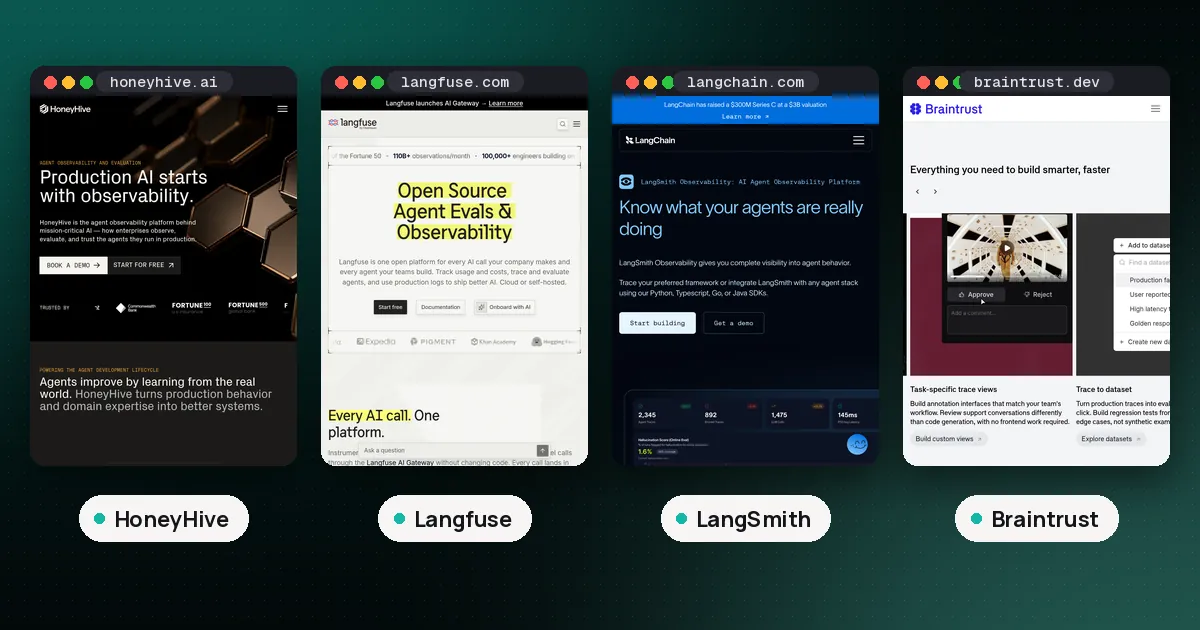
HoneyHive vs Langfuse is a choice between a hosted, enterprise first agent observability platform and an MIT licensed one you can run yourself. Pick Langfuse if you want to self host for free, start on a cheap paid plan or keep your options open. Pick HoneyHive if you are a regulated company that wants evaluation built around long agent sessions, managed deployment inside your own AWS account and a vendor contract, because past its free tier HoneyHive is sold only as a custom Enterprise deal.
Both products trace LLM calls and agent steps, run code and LLM judge evaluators, keep datasets, manage prompts and offer annotation queues for human review. The real differences sit in four places: how they count usage, what the free tier gets you, who can host the software and how each company is changing. Every price and limit below was checked on the official pages on November 13, 2026, and the usage counts come from a small SDK test we ran ourselves.
HoneyHive vs Langfuse at a glance
| Item | HoneyHive | Langfuse |
|---|---|---|
| License | Proprietary platform; Python SDK is MIT | MIT core; some enterprise features need a license key |
| Owner | Independent startup | ClickHouse (acquired January 2026) |
| Free plan | Developer: 10,000 events a month, up to 5 users, 30 days of data | Hobby: 50,000 units a month, 2 users, 30 days of data |
| First paid plan | Enterprise, custom price | Core, $29 a month with 100,000 units |
| Billing unit | Event (trace span plus metric) | Unit (trace plus observation plus score) |
| Self hosting | Enterprise only, deployed by HoneyHive on AWS | Free with Docker Compose or Kubernetes |
| Strongest at | Long agent sessions, enterprise data boundaries | Openness, price, framework coverage |
Sources: HoneyHive pricing, Langfuse pricing and Langfuse billable units.
How each one models a trace
HoneyHive uses what it calls a wide event model. Every record (a model call, a tool call or a chain step) carries its inputs, outputs, timing, metrics, metadata, feedback and errors in one row, and events nest under a session, which is itself an event at the root of the tree (tracing concepts). HoneyHive picked the word session over trace because one session can hold a single request or a whole multi turn conversation. There are only three child event types: model, tool and chain.
Langfuse uses traces made of observations, with richer observation types (generation, embedding, agent, tool, retriever, evaluator, guardrail and more), and stores scores as separate records linked to a trace or observation. Sessions in Langfuse group several traces into one conversation.
Both are built on OpenTelemetry. HoneyHive accepts OTLP over HTTP and maps OpenInference and OTel GenAI attributes to its own fields. Langfuse accepts OTLP too, and its SDK is an OpenTelemetry span processor underneath. If you already instrument with an OpenTelemetry library, our OpenLLMetry vs Langfuse guide explains how the capture layer and the platform fit together, and the same idea applies to HoneyHive.
One practical note: the HoneyHive Python SDK needs Python 3.11 or newer, and so does the current Langfuse Python SDK, so older runtimes need an upgrade for either one.
What we tested: one agent run, two meters
Pricing pages describe units in the abstract, so we measured them. We wrote the same toy agent for both SDKs: a parent function called answer that calls a retrieve tool step and a generate model step, then attaches one quality score of 0.8. We ran it three times with each SDK and pointed both at a local server that recorded every request.
What Langfuse sent:
- 9 spans over OTLP (protobuf) to
/api/public/otel/v1/traces: threeanswer, threeretrieve, threegenerate. - 3 scores in a separate JSON request to
/api/public/scores. - Each run became its own trace.
What HoneyHive sent:
- One call to
/session/startwhen the tracer was created. - 9 spans over OTLP (JSON) to
/opentelemetry/v1/traces, with the quality score stored as ahoneyhive_metrics.qualityattribute on eachanswerspan rather than as a separate record. - All three runs landed in the same session, because the tracer opens one session when it starts. In a web server you call
create_session()once per request instead, as the tracer initialization docs show.
Now apply each vendor's formula. Langfuse counts traces plus observations plus scores, so one run is 1 + 3 + 1 = 5 units. HoneyHive's pricing FAQ says total events equal trace spans plus metrics, so one run is 3 + 1 = 4 events (the page does not say whether the session record itself counts).
On that basis, the free tiers stretch very differently:
| Plan | Allowance | Runs of our toy agent per month |
|---|---|---|
| HoneyHive Developer | 10,000 events | about 2,500 |
| Langfuse Hobby | 50,000 units | about 10,000 |
| Langfuse Core ($29) | 100,000 units, then $8 per 100,000 | about 20,000 before overage |
Real agents emit far more spans than our toy, so scale these numbers down for your own app. The ratio is what matters: on the free plans, Langfuse fits about four times as much of the same workload.
HoneyHive pricing vs Langfuse pricing
HoneyHive has two plans (pricing):
- Developer, free: 10,000 events a month, up to 5 users, one workspace, 30 day retention, 1,000 requests a minute, automated and human evaluations, prompt versioning, CI integration and community support. No credit card.
- Enterprise, custom price: custom limits and retention, unlimited users and workspaces, SAML SSO, custom roles, uptime SLA, BAA, a dedicated account manager and optional self hosted, hybrid or single tenant deployment.
HoneyHive also offers startup discounts for companies that have raised less than $5 million in total. There is no self serve middle plan, so the step after 10,000 events is a sales conversation.
Langfuse has four Cloud plans (pricing):
- Hobby, free: 50,000 units, 2 users, 30 days of data, 1 annotation queue, 2 alerts.
- Core, $29 a month: 100,000 units included, then $8 per 100,000 units, unlimited users, 90 days of data.
- Pro, $199 a month: 3 years of data, retention controls, higher rate limits, SOC 2 and ISO 27001 reports and a BAA. An optional Teams addon at $300 a month adds enterprise SSO and project level roles.
- Enterprise, $2,499 a month: audit logs, SCIM, SLAs and a named support engineer.
Extra units get cheaper with volume: $7 per 100,000 from 1 million, $6.50 from 10 million and $6 above 50 million. Langfuse also lists discounts for startups, research, nonprofits and open source projects. Our guide on whether Langfuse is free for commercial use covers what the MIT license allows if you self host instead.
Evaluations and agent analysis
Both platforms treat evaluation as a core feature, and the gap is smaller than the pricing gap.
HoneyHive runs server side Python and LLM evaluators on production traces with sampling, client side evaluators in your code during experiments, and human evaluators through annotation queues. Its evaluator template list includes code checks such as JSON schema validation, SQL parsing, ROUGE and BLEU, and LLM judge templates aimed at agents: tool usage, plan coverage, trajectory plan faithfulness, failure recovery and policy compliance, plus conversation level checks for user frustration and resolution. In 2026 it added a trajectory view that draws a session as a bubble chart of steps, a conversation view for multi agent sessions, and rebuilt dashboards (product changelog).
Langfuse runs LLM judge evaluators on live traces and on experiments, supports code evaluators, keeps datasets, runs experiments from the SDK or the UI and in CI, and has annotation queues and custom dashboards. Free and Core plans cap annotation queues (1 and 3) and alerts (2 and 20), which matters for teams that lean on human review.
If you are deciding how much to trust either tool's judge scores, read our explainer on LLM as a judge first. For agent work specifically, HoneyHive's templates are a faster start; Langfuse gives you the building blocks and more freedom to wire your own.
Self hosting and data control
This is the sharpest difference.
Langfuse is open source, and its self hosting docs say you run the same infrastructure that powers Langfuse Cloud: a web container, a worker container, PostgreSQL, ClickHouse, Redis or Valkey and S3 compatible storage. You can start with Docker Compose on one machine and move to Kubernetes with Helm or Terraform on AWS, Azure or GCP. Self hosted Langfuse has no usage billing; only some addon features need an enterprise license key.
HoneyHive self hosting is an Enterprise feature that HoneyHive deploys and manages for you (self hosting overview). The supported platform today is AWS EKS with Terraform and Helm, either in a dedicated AWS account you provision or inside your own VPC. Its v2 release on May 5, 2026 split the product into a control plane that holds only metadata and one or more data planes that keep raw inputs, outputs, datasets and evaluator compute. That split is the main reason a security team might prefer HoneyHive: evaluators run where the sensitive transcripts live, and only scores and labels flow upward.
Ownership and pace of change
ClickHouse acquired Langfuse in January 2026 and said the core stays MIT licensed and self hostable, with Langfuse Cloud running as a standalone service. Releases still come quickly: v4.80.0 shipped on November 13, 2026, and Langfuse added its own AI gateway in November.
HoneyHive remains independent. It shipped v2 in May, kept v1 available for six months after each customer's migration, and its changelog shows steady updates through November 5, 2026, such as project scoped API keys for annotation queues and events. Its pricing page names the Commonwealth Bank of Australia as a production customer.
Moving between them
HoneyHive publishes a step by step Langfuse migration guide. It offers two paths: swap the Python SDK (Langfuse @observe becomes HoneyHive @trace, and the Langfuse OpenAI wrapper and LangChain callback become OpenInference instrumentors), or keep your OpenTelemetry instrumentation and point an OTLP exporter at HoneyHive. Points to plan for:
- Langfuse scores become HoneyHive metrics on a span or session.
- HoneyHive has no Langfuse importer. History has to be rebuilt through its sessions and events APIs, keeping old IDs in metadata.
- The Langfuse
latestprompt label has no direct mapping, and message placeholders must move into your code. - Never run both SDKs on the same client, or every call is recorded twice. To send data to both during a trial, use two exporters in an OpenTelemetry Collector.
Going the other way is simpler if your app already emits OpenTelemetry, since Langfuse accepts OTLP directly.
Which should you pick?
- Small team, startup or side project: Langfuse. The free tier goes about four times further on the same workload, and Core at $29 is a real paid step that HoneyHive does not offer.
- You must keep data in house but have no budget for a contract: Langfuse, self hosted.
- Regulated enterprise running long, multi agent sessions: HoneyHive is worth a trial. The control plane and data plane split, agent focused evaluator templates and managed deployment in your AWS account are built for that buyer.
- Still undecided: compare both against hosted options in our LLM observability tools roundup, or see how Langfuse stacks up against LangChain's product in Langfuse vs LangSmith.
FAQ
Is HoneyHive open source?
No. The HoneyHive platform is proprietary. Its Python SDK is published on PyPI under the MIT license (version 1.8.1 when we checked), but the server cannot be downloaded and run without an Enterprise agreement. Langfuse's core server is MIT licensed.
Is HoneyHive free?
Yes, up to a point. The Developer plan is free with 10,000 events a month, up to 5 users and 30 days of retention, with no credit card. Beyond that, HoneyHive sells only a custom priced Enterprise plan.
Can you self host HoneyHive?
Only on the Enterprise plan. HoneyHive deploys and manages it in your AWS account or VPC on EKS, either fully self hosted or as a hybrid where HoneyHive runs the control plane and you run the data plane.
Does HoneyHive support OpenTelemetry?
Yes. It ingests OTLP over HTTP, its Python SDK is built on OpenTelemetry, and it auto instruments popular libraries through OpenInference. Attributes it does not recognize, including Langfuse specific ones, are kept as metadata.
Which is cheaper, HoneyHive or Langfuse?
For most small and midsize teams, Langfuse. In our test the same agent run cost 4 HoneyHive events or 5 Langfuse units, but the Langfuse free plan includes five times the allowance, and its paid plans start at $29 a month with published overage rates. HoneyHive's Enterprise price is not public.