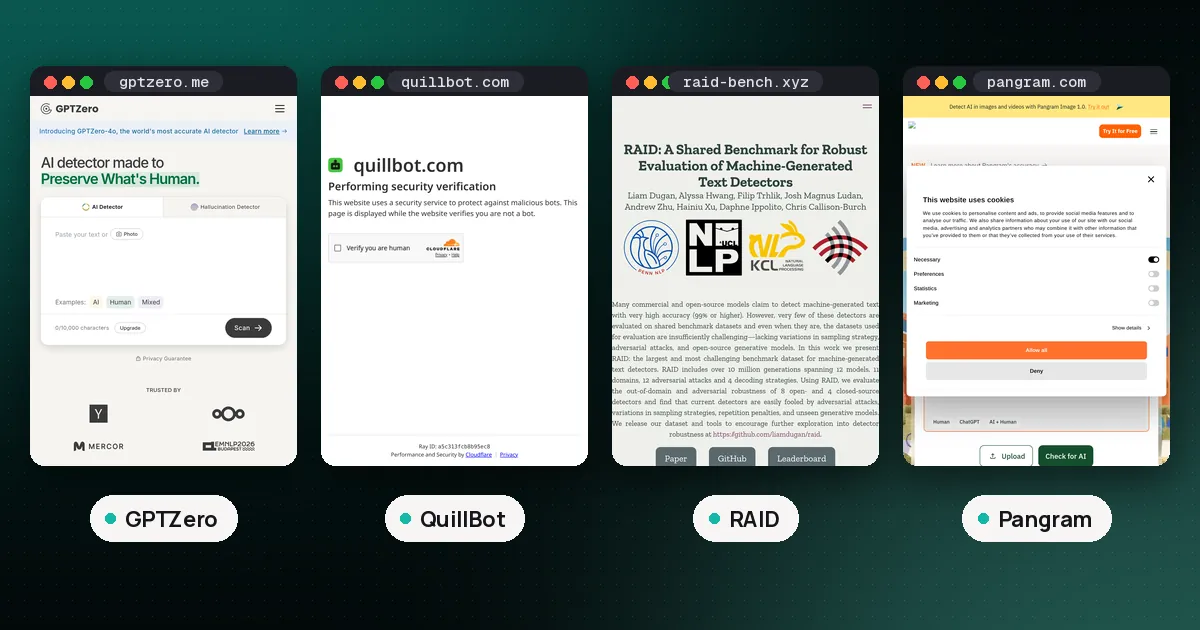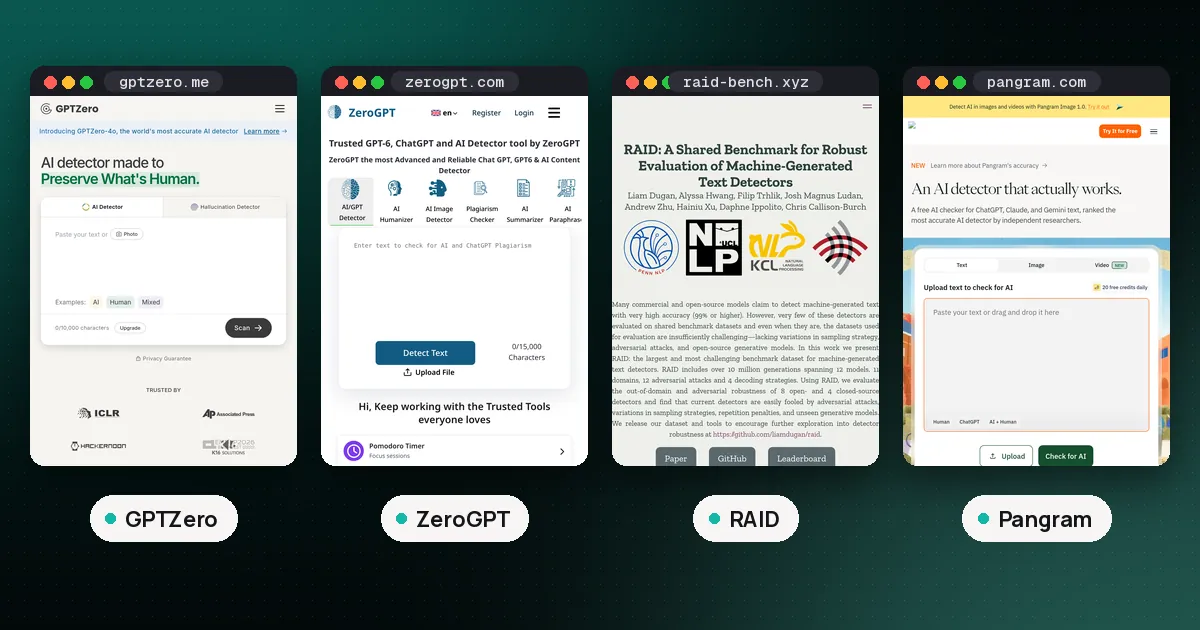
GPTZero vs ZeroGPT is a choice between two unrelated AI detectors with nearly the same name, and the evidence favors GPTZero when a wrong accusation would hurt someone. In every independent test we found, GPTZero flagged human writing far less often. ZeroGPT sometimes catches more AI text, especially reworded AI text, but it also flags much more human writing, and on the RAID benchmark it could not get its false alarm rate below 16.9 percent at any setting. ZeroGPT's advantages are price and its free paste box, which takes about 15,000 characters per check.
So use GPTZero when the result matters, and treat ZeroGPT as a quick, rough second opinion. Neither should be the only evidence against a student or writer. We checked both pricing pages, GPTZero's RAID results file and five independent studies on November 13, 2026. We did not run scans in either tool for this guide.
GPTZero vs ZeroGPT at a glance
| Item | GPTZero | ZeroGPT |
|---|---|---|
| Who makes it | GPTZero, now part of Superhuman (owner of Grammarly) | ZeroGPT.com, a separate company |
| Free use | 10,000 words a month, up to 10,000 characters per scan | About 15,000 characters per check |
| Cheapest paid plan | Premium: $23.99 a month, or $155.88 a year | Pro: $14.99 a month, or $107.88 a year |
| How usage is metered | Words per month | Characters per check |
| RAID benchmark | Leaderboard entry: 95.72% of AI text caught at a 1% false alarm rate | Not on the leaderboard; the 2024 paper found a 16.9% false alarm floor |
| Human text wrongly flagged as AI (three outside studies) | 0% in all three | 16.7% to 24.6% |
| Best fit | Teachers, students checking their own work, editors | Casual checks you will verify elsewhere |
Two different companies, one confusing name
The names cause real mix ups, so it helps to say it plainly: GPTZero and ZeroGPT are separate products from separate companies. GPTZero was one of the first dedicated AI text detectors (Superhuman calls it the first), and on September 30, 2026 Superhuman, the company behind Grammarly, said GPTZero is now part of it (Superhuman announcement). It sells mainly to schools and teachers, with a Chrome extension, Google Classroom and Canvas tools, and a Writing Report that replays how a document was typed. Our walkthrough on how to use GPTZero in Google Docs covers that setup.
ZeroGPT, at zerogpt.com, is a general writing toolbox built around a free detector. Its menu also offers a humanizer, paraphraser, summarizer, translator, grammar checker and chatbot, and it can be used inside WhatsApp and Telegram (ZeroGPT homepage). Its detector returns a percentage of AI text and, per its pricing page, works at document, paragraph and sentence level. One detail worth weighing: ZeroGPT sells an AI humanizer, a tool meant to make AI text read as human, on the same site as its detector.
GPTZero vs ZeroGPT accuracy: what the evidence shows
The short version is that the two tools fail in opposite directions. GPTZero is conservative: it rarely calls human writing AI, and its usual weakness is missing AI text that has been paraphrased or mixed with human text. ZeroGPT is looser: it flags more text of every kind, which helps it catch some reworded AI writing but means more innocent writers get flagged.
RAID benchmark
RAID is the largest shared test for AI text detectors, built by researchers at the University of Pennsylvania and explained in our RAID benchmark guide. Its 2024 paper ran both tools. To compare detectors fairly, the authors set each one's cutoff so that it flags only a fixed share of human texts, 5 percent in that test. ZeroGPT could not get there. Even at its strictest setting it still flagged 16.9 percent of human texts overall, including 29 percent of news articles, 48 percent of Wikipedia passages and 52 percent of recipes (RAID paper). GPTZero reached the 5 percent target.
GPTZero later submitted to the public RAID leaderboard. We read its results file, an entry dated October 7, 2025, in the RAID repository. With the false alarm rate held at 1 percent, it caught 95.72 percent of AI texts with no tricks applied and 92.93 percent with every attack included (606,676 of 652,800). Its weak spot was paraphrasing, where it caught 71.6 percent. ZeroGPT has no leaderboard entry. RAID's AI text comes from models up to GPT-4, so treat these as relative results, not a promise about 2026 chatbots.
Scholarly abstracts
A 2025 study in PeerJ Computer Science tested 72 published abstracts against versions written by ChatGPT o1 and Gemini 2.0 Pro (Pratama 2025). GPTZero was right 97.22 percent of the time and flagged none of the human abstracts. ZeroGPT was right 64.35 percent of the time, flagged 16.67 percent of the human abstracts and missed 45 percent of the AI ones. The author also noticed that ZeroGPT labeled some human abstracts as AI even when their score was under 30 percent, which suggests its cutoff is lower than the 50 percent most people assume.
There was a catch for GPTZero. When human abstracts were only polished by AI, GPTZero called 18 percent of them fully AI, and 25 percent for authors who were not native English speakers. ZeroGPT rarely did that, but it scored 58 percent of those polished abstracts as 0 percent AI.
Student essays
The 2024 DUPE paper ran both tools on college essays (DUPE paper). ZeroGPT wrongly flagged 24.64 percent of human essays and missed 19.14 percent of unedited ChatGPT essays. GPTZero flagged no human essays and missed 2.5 percent. After the researchers paraphrased the AI essays, both tools missed many more, ZeroGPT the most.
Polish and English texts
A 2026 study from Lublin University of Technology checked 150 samples in Polish and English with the free web versions in May 2026 (Brodacki and Plechawska-Wójcik 2026). This is the one study where ZeroGPT came out ahead overall, with 64.0 percent accuracy against GPTZero's 58.7 percent, though the gap was not statistically significant. Read the details, though. Both caught nearly all fully AI texts. ZeroGPT won on AI paraphrased texts, which GPTZero mostly passed as human. But GPTZero labeled all 30 human texts correctly, while ZeroGPT called 6 of the 15 Polish human texts AI and was unsure about 8 more across both languages.
Persian abstracts
A 2026 study of Persian research abstracts is the warning for other languages (Shamsi and colleagues 2026). Both tools misread nearly every human abstract: ZeroGPT got 2.08 percent of them right and GPTZero none. GPTZero's own site said its Persian support was still being trained at the time. Outside English, neither tool's verdict should carry much weight.
Newer models have not been tested head to head
GPTZero made a new model, GPTZero 4o, its default on September 20, 2026, and reports one false positive in 10,402 student essays on its own test (GPTZero 4o announcement). That is a vendor figure. Most of the studies above used earlier versions, and a June 2026 study found the older GPTZero put 70 percent of fully AI academic papers in its lowest band (International Journal for Educational Integrity). No outside lab has tested GPTZero 4o against the current ZeroGPT yet.
What each vendor claims
ZeroGPT's homepage advertises 98.4 percent detection accuracy and a false positive rate under 1 percent across 35 or more model families (ZeroGPT homepage). It does not publish the test set behind those numbers. The independent false positive figures we found for ZeroGPT ranged from 16.7 to 24.6 percent in three studies, and far higher on Persian text, so we would not rely on the homepage figure.
GPTZero publishes more of its testing, including its RAID submission and the essay sets named in its model announcements, and most outside studies agree it rarely flags human writing. Its own figures still come from tests it designed. The broader picture, including why a single accuracy number misleads, is in our guide on whether AI detectors are accurate.
Free limits and prices
Both pricing pages load their plans in the browser, so we read the plan data behind each page on November 13, 2026.
GPTZero. The free plan gives 10,000 words a month, up to 10,000 characters per scan, a basic scan with one free Advanced Scan for sentence highlights, and batches of up to 3 files (GPTZero support). Premium is $23.99 a month or $155.88 a year (about $12.99 a month) for 300,000 words and 50,000 characters per scan. Professional is $45.99 a month or $299.88 a year for 500,000 words, 150,000 characters per scan and LMS integration (GPTZero pricing). Separate API plans start at $45 a month for 300,000 words.
ZeroGPT. The free plan is $0 forever with no credit card and allows about 15,000 characters per check, which is roughly 2,000 to 2,500 words of typical English prose by our estimate. Pro is $14.99 a month or $107.88 a year (about $8.99 a month) and Plus is $21.99 a month or $167.88 a year, both with 100,000 characters per check. Max is $30.99 a month or $239.88 a year with 150,000 characters per check (ZeroGPT pricing). Paid plans drop the ads and add batch file checks. The API runs on a prepaid balance.
ZeroGPT is cheaper and gives more text per free check. GPTZero meters a monthly word budget, which suits steady classroom use.
Which one should you use?
- Teachers and schools: GPTZero. It has the lower false positive record, classroom integrations and a Writing Report that shows how a document was written, which is better evidence than any score. If your school licenses Turnitin, compare in our GPTZero vs Turnitin guide.
- Students checking their own work: GPTZero's free plan. If ZeroGPT flags your own writing, the studies above suggest that happens often to human text.
- Writers and editors doing quick checks: ZeroGPT's free box is fine for a fast look, but confirm any flag with a second detector before acting. If you already pay for QuillBot, its bundled detector is covered in GPTZero vs QuillBot.
- Anyone who needs the lowest chance of a false accusation: look beyond both at Pangram, which led the June 2026 study; see Pangram vs GPTZero. For free options side by side, see the best free AI detector guide.
How to use either one without hurting someone
- Check longer passages where you can. A few sentences give either tool very little to go on.
- Run the same text through a second detector. GPTZero and ZeroGPT disagree often, and a flag from ZeroGPT alone is weak evidence.
- Look at the draft history. Version history in Google Docs or GPTZero's Writing Report tells you more than any percentage.
- Be careful with writers whose first language is not English, and with text in any other language.
- Talk to the writer before deciding anything. A score should start a conversation, not end it.
FAQ
Is GPTZero better than ZeroGPT?
For most uses, yes. Independent tests consistently found GPTZero flags far less human writing, and it has a public RAID leaderboard entry. ZeroGPT caught more AI paraphrased text in one 2026 study, and its free plan allows more text per check.
Is ZeroGPT accurate?
Not reliably enough to accuse anyone. Three independent studies found ZeroGPT wrongly flagged 16.7 to 24.6 percent of human texts, and the RAID paper could not push its false alarm rate below 16.9 percent. Its advertised 98.4 percent accuracy comes from tests it has not published.
Is ZeroGPT the same as GPTZero?
No. They are separate companies with similar names. GPTZero is owned by Superhuman, the company behind Grammarly. ZeroGPT is an independent site at zerogpt.com that also sells a humanizer and other writing tools.
Which is free, GPTZero or ZeroGPT?
Both have free plans. GPTZero gives 10,000 words a month at up to 10,000 characters per scan. ZeroGPT's free plan allows about 15,000 characters per check, and its paid plans are cheaper than GPTZero's.
Why do GPTZero and ZeroGPT give different scores for the same text?
They use different models trained on different data, and they set different cutoffs for calling text AI. ZeroGPT's cutoff appears to be lower, so it flags more text overall. A big gap between the two is a sign that neither score is solid.