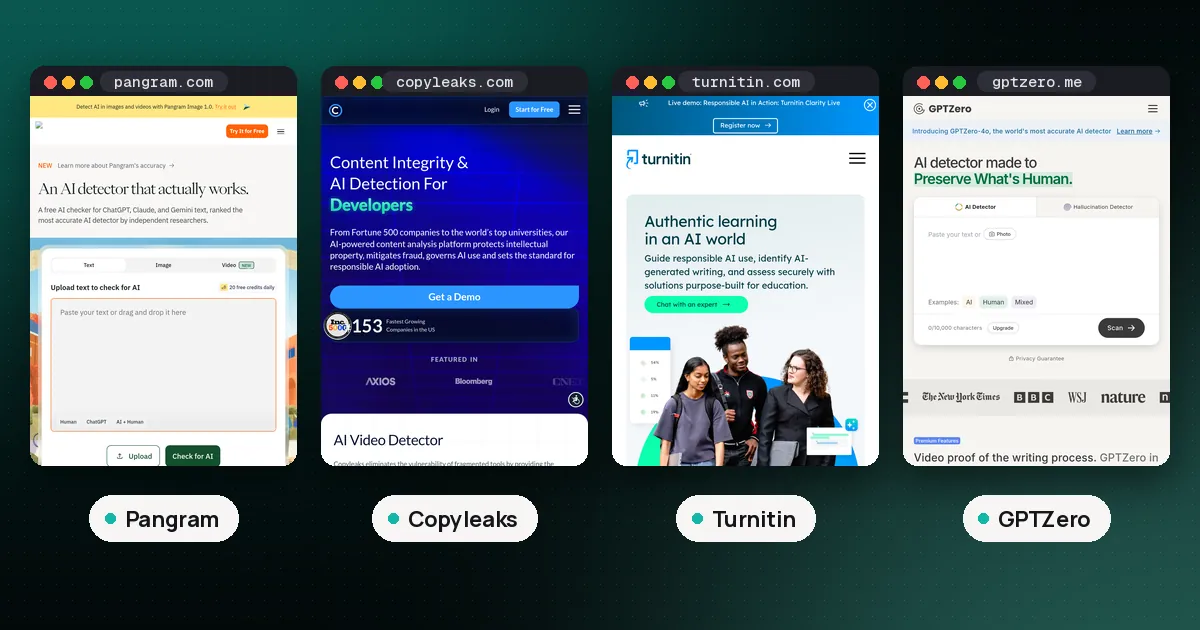
Pangram vs Copyleaks comes down to what you need checked. Pick Pangram if AI detection is the main job: it costs about a tenth as much per word, has a free plan that renews every day, and posted the best results in the most recent independent study that tested both. Pick Copyleaks if plagiarism checking is the main job and AI detection is a bonus: it matches text in more than 100 languages, plugs into seven learning platforms, and its Pro plan covers 25 users for one price. Copyleaks earned its reputation in 2023 tests on GPT-3.5 and GPT-4 essays. In a 2026 study on newer AI writing, it missed most of the AI text Pangram caught.
We read both pricing pages, both vendors' accuracy reports and the outside studies on November 10, 2026. We did not run either detector ourselves, so every accuracy number below comes from a named source.
Pangram vs Copyleaks at a glance
| Item | Pangram | Copyleaks |
|---|---|---|
| Free use | 20 credits a day (up to 2,000 words), renews daily, no card | Scans up to 25,000 characters without an account; new accounts get a small credit grant whose size is not published |
| Entry paid plan | Individual: 20 dollars a month (15 yearly), 300,000 words a month | Personal: 16.99 dollars a month (13.99 yearly), 100 credits, up to 25,000 words a month |
| Larger plan | Professional: 65 dollars a month (45 yearly), 1,500,000 words | Pro: 99.99 dollars a month (74.99 yearly), 1,000 credits, up to 250,000 words, 25 seats |
| How words are counted | 1 credit per 100 words, rounded up | 1 credit per 250 words, rounded up |
| Plagiarism | Similarity check on paid plans, 5 credits per scan | Core product, in the same report as the AI score, 100+ languages |
| AI detection languages | 24 officially supported | 30+ |
| Result style | Segments labeled Human, AI Assisted or AI Generated | Percentage of AI text, highlighted passages, AI Logic explanations on paid plans |
| Public API price | 0.05 dollars per 100 words | Through sales (Enterprise and Education) |
| Current text model | Pangram 4.1 (October 19, 2026) | V11 (tested September 10, 2026) |
Sources: Pangram pricing, Pangram credit help, Pangram free account help, Pangram 4.1 model card, Copyleaks pricing, Copyleaks credit help, Copyleaks AI Detector page and the Copyleaks V11 testing methodology.
Copyleaks pricing vs Pangram pricing per 1,000 words
This is the widest gap between the two, and it is easy to miss because Copyleaks prices in credits.
- Pangram Individual at 20 dollars a month covers 300,000 words: about 6.7 cents per 1,000 words, or 5 cents on the yearly price.
- Copyleaks Personal at 16.99 dollars a month covers 100 credits, which is 25,000 words: about 68 cents per 1,000 words, or 56 cents on the yearly price.
- Pangram Professional at 65 dollars a month covers 1,500,000 words: about 4.3 cents per 1,000 words.
- Copyleaks Pro at 99.99 dollars a month covers 250,000 words: about 40 cents per 1,000 words.
So for pure AI checks, Pangram gives roughly ten times more words per dollar at each level. Two details narrow the picture. Copyleaks runs the AI check and the plagiarism check in one report, so if you need both on every document, you get both from one scan. Its pricing page does not say whether that combined scan draws more credits than an AI check alone, so test it on your account. Pangram charges a flat 5 credits (the cost of 500 words) for each plagiarism check.
Rounding matters for short texts too. Copyleaks counts a 251 word essay as 2 credits, the cost of 500 words. Pangram counts it as 3 credits of 100 words each.
Teams change the math again. Copyleaks Pro includes 25 user seats, so a department that shares 250,000 words a month pays one bill. Pangram's published plan summary lists Team at 20 dollars per seat a month, which costs more for 25 people but gives each seat 300,000 words.
Read the Copyleaks billing rules before you upgrade. Its pricing FAQ says plans do not stack, so switching plans replaces your current one and forfeits unused credits. Refunds are considered only within the first 10 days of a billing cycle and only if you have used no credits.
Is Copyleaks free? Free use on each tool
Copyleaks lets anyone paste up to 25,000 characters into its AI Detector page without logging in, and a free account adds a small grant of credits. Copyleaks does not publish how many, and review sites report different numbers, so check your own dashboard. Sentence by sentence detail needs an account, and AI Logic needs a subscription.
Pangram's free plan is an ongoing daily allowance: 20 credits a day, enough for up to 2,000 words, plus 3 image scans a day, AI Assisted labels and file upload with OCR. On November 10, 2026, its pricing page also offered a 7 day free trial of the Individual plan. Our guides to whether Pangram Labs is free and using Pangram on Substack cover those limits. Our best free AI detector roundup compares other vendors.
If you check one long report once, the Copyleaks no login box is the easier choice. If you check a few essays every week, Pangram's daily plan lasts.
Is Copyleaks accurate? What the studies show
Both vendors publish excellent numbers on their own data. The more useful question is what happened when someone else ran the test, and on what kind of text.
Copyleaks did well in 2023
William Walters tested 16 detectors on 126 first year composition essays: 42 written by students, 42 by GPT-3.5 and 42 by GPT-4. Copyleaks and Turnitin classified all 126 correctly with no uncertain answers, and Originality.ai was close behind (Walters, Open Information Science, 2023). Most other detectors failed on GPT-4 text. Pangram was not in that study. Much of Copyleaks' reputation for accuracy dates from results like this one.
Copyleaks struggled in 2026
Researchers at Vrije Universiteit Brussel tested GPTZero, Pangram, Copyleaks and Turnitin on 160 academic papers of at least 4,000 words with known authorship (International Journal for Educational Integrity, June 29, 2026). The fully AI papers came from ChatGPT Deep Research mode in May 2025. The hybrid papers had the literature review and conclusion swapped for GPT-4o text, and the humanized set rewrote those sections to sound like a student.
- Human papers: Copyleaks and Pangram both cleared all 40 human papers, with an average error of zero. No false positives.
- Fully AI papers: Copyleaks put 75 percent of them in the lowest band (under 20 percent AI) and the rest between 20 and 40 percent. On average it underestimated the AI share by about 86 points. Pangram's strict accuracy was 65 percent (a score of 80 percent AI or higher), and 97.5 percent when partly correct scores are counted.
- Hybrid and humanized papers: Copyleaks landed inside the true range for 30 percent of hybrid and 22.5 percent of humanized papers. Pangram did so for 92.5 percent of both.
The authors concluded that only Pangram produced satisfactory results and that no detector score should be the sole evidence in a misconduct case. Two caveats apply. The tests predate Copyleaks V11, and Pangram's 4.1 model card reports a rerun on the study's public AI subset (39 papers, no misses), which is a vendor rerun, not an independent one.
What each vendor reports about itself
Copyleaks' V11 report, tested September 10, 2026, shows 923 of 326,120 English human texts flagged (about 0.3 percent) and 826 of 128,225 AI texts missed (about 0.6 percent) at the default Balanced setting. It also documents three sensitivity levels: Extra Safe (0.16 percent false positives, 0.88 percent misses), Balanced, and Extra Sensitive (0.66 percent false positives, 0.49 percent misses) for humanized text.
Pangram's 4.1 model card reports 70 false positives in 781,981 cleaned English web documents (0.009 percent) and a 0.37 percent miss rate across 520,000 texts from 26 current models, including Claude, GPT-5, Gemini and Grok models.
These figures come from different datasets, so they do not rank the two tools. They do show that Copyleaks gives you a dial for trading false positives against misses, while Pangram publishes one calibration, set at roughly 1 false positive in 10,000.
Public benchmarks that include neither
Neither vendor had a submission in the RAID leaderboard repository when we checked on November 10, 2026, so there is no shared attack test for this pair. Our RAID benchmark guide explains what that board measures. Epoch AI's July 2026 test included Pangram but not Copyleaks. For the wider evidence on false flags and misses, see are AI detectors accurate.
Plagiarism, languages and integrations
Plagiarism is where Copyleaks leads. Matching copied text is its core product. Plans include plagiarism checks in more than 100 languages, a Shared Data Hub of user submitted documents for matching, and AI Source Match, which flags passages that already appear elsewhere online. Pro adds cross language plagiarism (catching text translated from another language) and whole website scans from a sitemap. Pangram includes a similarity check on paid plans, but it is an add on to a detector.
Languages. Copyleaks lists AI detection in more than 30 languages and publishes its own accuracy by language: for example, 99.2 percent of English AI text caught, but 93.1 percent of Portuguese. Pangram's model card lists 24 supported languages, including Arabic, Hindi, Persian, Urdu and Vietnamese, with false positive rates by language.
Learning platforms. Copyleaks integrates with Canvas, Moodle, D2L Brightspace, Schoology, Sakai, Edsby and Blackboard, priced per full time student. Pangram lists Canvas, Brightspace, Moodle and Google Classroom, plus a Chrome extension that works inside any LMS. For Blackboard, Schoology, Sakai or Edsby, only Copyleaks lists a native plugin.
Everyday tools. Both offer a browser extension, a Google Docs add on and an MCP server for AI assistants. Copyleaks' extension runs on Chrome, Edge and Firefox. Pangram adds Gmail and social feed scanning.
Minimum length. Copyleaks needs at least 255 characters on the web app and 350 in its extension and API. Pangram is meant for 50 words or more and shows lower certainty under 150.
Who should pick Pangram
- People who mainly need AI detection. It costs a tenth as much per word and led the 2026 study on current AI writing.
- Teachers who check a few essays a week. The daily free allowance covers it.
- Policies that allow some AI editing. The AI Assisted label separates light edits from wholesale generation.
- Developers. A public API price of 0.05 dollars per 100 words, with no sales call.
If you are comparing Pangram with other consumer detectors, see Pangram vs GPTZero and Pangram vs Turnitin.
Who should pick Copyleaks
- Schools that need plagiarism checks first. One report covers matching in 100+ languages plus an AI score.
- Campuses on Blackboard, Schoology, Sakai or Edsby. Pangram lists no native plugin for those.
- Small teams that share volume. Pro covers 25 seats for one price.
- Reviewers who want to adjust strictness. Three sensitivity levels let you choose fewer false flags or fewer misses.
How to choose in an afternoon
- Gather 20 texts you know people in your setting wrote, including short ones and some by second language writers.
- Add 20 AI texts from the models your writers use, some edited and some run through a humanizer.
- Run them through Pangram Free and the Copyleaks no login box. Note every human text flagged and every AI text missed.
- If you use Copyleaks, try the same set at more than one sensitivity level.
- Price your real monthly word count on both pricing pages, with plagiarism included if you need it.
Treat any flag as a reason to talk with the writer, not as proof.
FAQ
Is Pangram better than Copyleaks?
For AI detection, the current evidence favors Pangram. In the 2026 Brussels study it found far more of the AI text in fully AI, hybrid and humanized papers, with no false positives. It also costs about a tenth as much per word. Copyleaks is the stronger choice for plagiarism checking and for schools on learning platforms Pangram does not support.
Is Copyleaks accurate?
It depends on the test. Copyleaks classified all 126 essays correctly in a 2023 study of GPT-3.5 and GPT-4 writing. In a 2026 study of ChatGPT Deep Research papers, it missed most of the AI text, though it never flagged a human paper. Its own V11 report shows about 0.3 percent false positives and 0.6 percent misses on its internal data.
Is Copyleaks free?
Partly. You can scan up to 25,000 characters without an account, and a free account gets a small, unpublished number of credits. Regular use needs a paid plan, starting at 16.99 dollars a month for 25,000 words.
How much does Copyleaks cost?
Personal is 16.99 dollars a month or 13.99 a month billed yearly, with up to 25,000 words a month. Pro is 99.99 dollars a month or 74.99 billed yearly, with up to 250,000 words and 25 seats. Education and Enterprise plans are quoted by sales.
Does Copyleaks check for plagiarism and AI at the same time?
Yes. For text, Copyleaks puts the AI score and plagiarism matches in one report. Pangram offers a similarity check on paid plans at 5 credits per scan.
Can Pangram or Copyleaks detect humanized AI text?
Pangram handled one humanizing prompt well in the 2026 study, landing inside the true range for 92.5 percent of humanized papers against 22.5 percent for Copyleaks. Copyleaks has since added an Extra Sensitive setting aimed at humanized text, but no outside study has tested it yet.