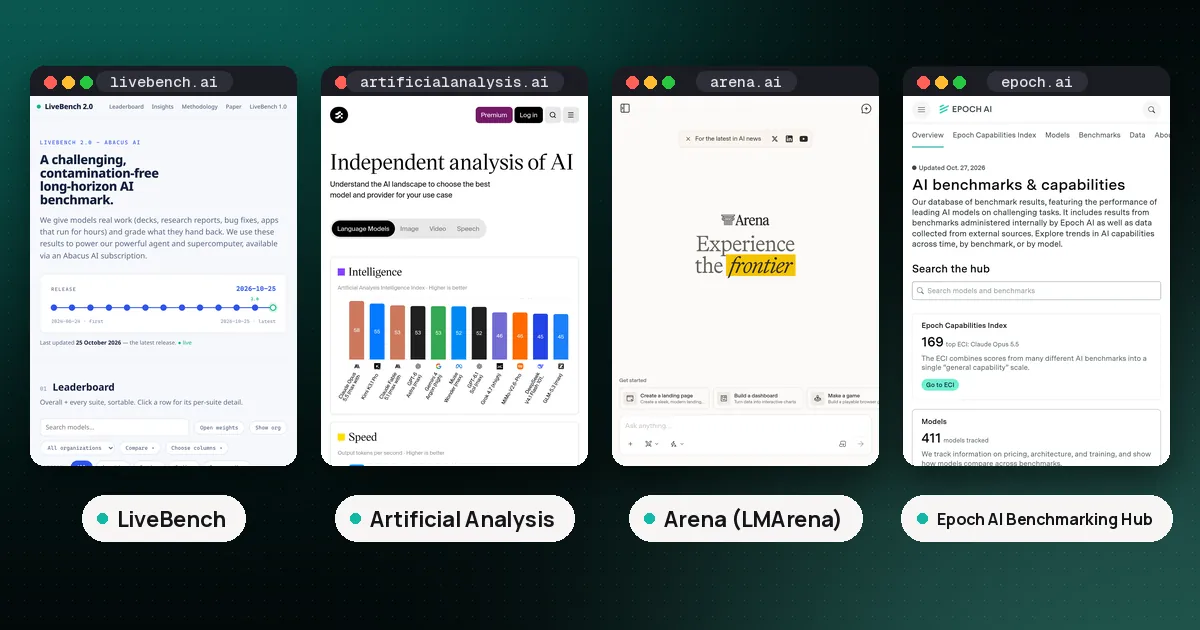
These coding agent benchmark rankings put the October 2026 results from four public leaderboards side by side: SWE-Bench Pro, FrontierCode, Terminal-Bench and the Artificial Analysis Coding Agent Index. Short answer: Claude Code running Claude Opus 5.5 at max effort sits first on the Artificial Analysis index (61.7) and on the official Terminal-Bench 4.0 board (64.8%), and Opus 5.5 also leads Cognition's FrontierCode 1.1 board (54.6%). On SWE-Bench Pro V2's hardest public subset, Claude Opus 5 in Claude Code leads at 98.0%. No single number settles it, and the gaps in the middle of every board are small enough to flip on a rerun.
This page ranks agents by published benchmark results only. Every score below was read from the official leaderboard on October 24, 2026. It is not a product review: for setup, features and how the tools feel to use day to day, see drydock.si's comparisons of GitHub Copilot vs Claude Code and Claude Code vs Codex vs Gemini CLI.
What "coding agent" means on these leaderboards
A coding agent is a model plus a harness: the program that gives the model tools (a shell, file edits, search), a system prompt, a turn limit and a way to submit work. Claude Code, Codex, Grok Build and Devin Fusion CLI are harnesses. Opus 5.5, GPT-6 Astra and Grok 4.7 are models. The same model can score very differently in two harnesses, so the leaderboards below label every row with both, plus the reasoning effort setting. If the harness idea is new, drydock.si's explainer on what an agent harness is covers it.
The four benchmarks and what each one measures
| Benchmark | Who runs it | Tasks | What passes |
|---|---|---|---|
| SWE-Bench Pro V2 | Scale AI | 642 public tasks; HARD-51 is the 51 hardest | Hidden tests pass with no regressions |
| FrontierCode 1.1 | Cognition (independent runs by Artificial Analysis) | 100 Main tasks, 150 Extended | Every blocker check passes; score 70% to 100% on top of that |
| Terminal-Bench 4.0 | Laude Institute | 66 terminal tasks on the Artificial Analysis run | The task's checker passes after a shell workflow |
| Artificial Analysis Coding Agent Index v2.0 | Artificial Analysis | 290 tasks across three benchmarks | Equal weighted mean of FrontierCode v1.1, Terminal-Bench 4.0 and SWE-Atlas-QnA-AA |
SWE-Bench Pro is the patch benchmark: an agent reads an issue in a real repository and must produce a change that makes new tests pass without breaking old ones. Scale released V2 on September 22, 2026 with 642 cleaned tasks, a network locked agent phase and regrading on a pristine image. Our SWE-Bench Pro guide explains the splits.
FrontierCode asks whether a maintainer would merge the change. It grades scope, test quality, style and code conventions as well as correctness, and any failed blocker scores zero. The tasks are private. Our FrontierCode explainer covers the rubric and the retired Diamond subset.
Terminal-Bench tests shell work rather than patches: building software, configuring tools, debugging an environment and finishing a multistep command line job. Each attempt is pass or fail.
The Artificial Analysis Coding Agent Index is a composite. Version 2.0, live since October 23, 2026, averages three components with equal weight: FrontierCode v1.1 (100 tasks), Terminal-Bench 4.0 (66 tasks) and SWE-Atlas-QnA-AA (124 repository question tasks from Scale AI, with grading adjusted by Artificial Analysis). Each benchmark score is the mean of three attempts per task.
Coding agent benchmark rankings: the combined table
The table is ordered by the Artificial Analysis Coding Agent Index v2.0, because it is the only board that runs every agent through the same three benchmarks. The last column shows the same agent and model on the official Terminal-Bench 4.0 board where it appears there.
| Rank | Agent and model (effort) | AA index | FrontierCode v1.1 (AA) | Terminal-Bench 4.0 (AA) | SWE-Atlas QnA (AA) | Terminal-Bench 4.0 (official board) |
|---|---|---|---|---|---|---|
| 1 | Claude Code, Opus 5.5 (max) | 61.7 | 56.0% | 63.1% | 65.9% | 64.8% |
| 2 | Devin Fusion CLI, Claude Opus 5.5 Max + GPT-6 Luna High | 61.5 | 53.6% | 62.6% | 68.3% | not listed |
| 3 | Claude Code, Sonnet 5.5 (max) | 59.3 | 47.6% | 66.2% | 64.2% | 61.8% |
| 4 | Muse Code, Muse Wonder Full (max) | 58.9 | 48.7% | 59.1% | 68.8% | not listed |
| 5 | Devin Fusion CLI, Claude Fable 5.1 XHigh + SWE-2 Medium | 58.7 | 51.6% | 56.1% | 68.3% | not listed |
| 6 | Claude Code, Fable 5.1 (max, with fallback) | 57.6 | 48.9% | 57.6% | 66.4% | 57.9% |
| 7 | Codex, GPT-6 Astra (max) | 54.7 | 49.3% | 55.6% | 59.1% | 58.2% |
| 8 | Codex, GPT-6.1 Sol (max) | 54.1 | 49.4% | 53.0% | 59.9% | 58.2% |
| 9 | Antigravity CLI, Gemini 4 Argon (high) | 53.2 | 48.6% | 56.1% | 55.1% | not listed |
| 10 | Devin Fusion CLI, GPT-6 Astra XHigh + SWE-2 Medium | 53.1 | 49.0% | 50.0% | 60.2% | not listed |
Sources, all checked October 24, 2026: Artificial Analysis coding agents leaderboard (index v2.0, data refreshed October 24) and the Terminal-Bench 4.0 leaderboard. The Artificial Analysis board listed 24 agent configurations on that date; the rest scored between 52.0 and 20.5.
Three things stand out. Claude Code with Opus 5.5 is first on the composite and on both Terminal-Bench boards. Two Devin Fusion CLI entries, which route between two models, land in the top five, even though neither model leads alone. And the FrontierCode column is tight: nine of the ten rows sit between 47.6% and 53.6%, and only the top row reaches 56.0%.
SWE-Bench Pro V2 HARD-51 ranking
Scale's SWE-Bench Pro V2 leaderboard ranks models with the harness named in each row. Every score on it is a multiple of 1/51 and the board's data table is labeled "hard", so we read it as the HARD-51 subset; Scale's page does not print that label above the table.
| Rank | Model (harness, effort) | Resolve rate |
|---|---|---|
| 1 | Opus 5 (Claude Code, xhigh) | 98.0% |
| 2 | Fable 5.1 (Claude Code, high) | 92.2% |
| 3 | Gemini 4 Argon (mini-swe-agent, high) | 92.2% |
| 4 | GPT-6 Astra (Codex, high) | 90.2% |
| 4 | Muse Wonder 1.0 (mini-swe-agent, xhigh) | 90.2% |
| 6 | Kimi-K3 (mini-swe-agent, max) | 88.2% |
| 6 | Sonnet 5 (Claude Code, xhigh) | 88.2% |
| 8 | GPT-5.6 Terra (Codex, xhigh) | 86.3% |
Source: Scale SWE-Bench Pro V2 leaderboard, checked October 24, 2026. Gemini 4 Argon shows 92.16 against Fable 5.1's 92.20, so they rounded to the same figure here. Opus 5.5 and GPT-6.1 Sol were not on this board on that date, so SWE-Bench Pro cannot be compared with the top of the table above.
Scale's older public board (V1 style, mini-swe-agent for the starred rows) still ranks Muse Spark 1.1 first at 61.5% ±3.1 and GPT-5.4 (xHigh) second at 59.1% ±3.6 (Scale SWE-Bench Pro leaderboard, checked October 24, 2026). Don't mix those numbers with V2.
FrontierCode 1.1 ranking on Cognition's board
Cognition publishes its own FrontierCode 1.1 Main board, ranked by model rather than by agent. The top ten on October 24, 2026:
| Rank | Model | Score |
|---|---|---|
| 1 | Claude Opus 5.5 | 54.6% |
| 2 | Claude Fable 5 | 53.5% |
| 3 | Claude Opus 5 | 53.4% |
| 4 | GPT-6 Astra | 53.3% |
| 5 | Claude Sonnet 5.5 | 52.1% |
| 6 | Claude Fable 5.1 | 50.9% |
| 7 | GPT-6.1 Sol | 50.2% |
| 8 | SWE-2 | 50.0% |
| 9 | GPT-6 Sol | 49.3% |
| 10 | Grok 4.6 | 48.0% |
Source: Cognition FrontierCode leaderboard, current revision, checked October 24, 2026. Runs flagged for unfair internet use are scored zero.
Why the coding agent rankings differ
Different skills. SWE-Bench Pro rewards a passing patch. FrontierCode rewards a patch a maintainer would accept. Terminal-Bench rewards shell competence. SWE-Atlas QnA rewards correct answers about a codebase. Claude Code with Sonnet 5.5 shows the effect: it posts the best Terminal-Bench score on the Artificial Analysis board (66.2%) but sits at 47.6% on FrontierCode there. Codex with DeepSeek V4.1 Flash runs the other way, 52.6% on FrontierCode and 28.3% on Terminal-Bench.
Different harnesses. Opus 5.5 scores 56.0% on FrontierCode inside Claude Code on the Artificial Analysis board, 54.6% on Cognition's own board, and 52% in the Artificial Analysis Stirrup harness in its October 12 FrontierCode run. Same model, three numbers.
Different runs of the same benchmark. Grok Build with Grok 4.7 (xhigh) shows 37.6% on the official Terminal-Bench 4.0 board and 33.3% on the Artificial Analysis run. Sonnet 5.5 in Claude Code goes the other way: 61.8% official, 66.2% on Artificial Analysis. Trial counts, task sets and dates differ.
Saturation. HARD-51 exists because the full V2 public set stopped separating the leaders, and it is already near the top for several agents. One task is about two points there, so 92.2% and 90.2% are one task apart.
Uncertainty. The official Terminal-Bench board prints a 95% confidence half width of about 3 points for the top rows (3.11 for Opus 5.5 in Claude Code). Rows within a few points of each other are statistically close.
Coverage gaps. Not every agent is on every board. Devin Fusion CLI, Muse Code and Antigravity CLI do not appear on the official Terminal-Bench board, and SWE-Bench Pro V2 did not list Opus 5.5 on October 24.
For the bigger picture on why knowledge exams and coding benchmarks tell different stories, see MMLU vs SWE-bench and our leaderboards comparison.
How to read these rankings
- Check the pair. A row is a model in a harness at an effort level. Quote all three.
- Check the version. SWE-Bench Pro V1 and V2, FrontierCode 1.0 and 1.1, and the index's v1 and v2.0 are not comparable.
- Look at the components. A composite can hide a weak spot. Read the three columns before the headline.
- Treat small gaps as ties. Two or three points rarely survive a rerun on boards of 51 to 124 tasks.
- Date every number. These boards change weekly. Every score here is as of October 24, 2026.
- Test on your own work. Public results are a shortlist. Our guide to evaluating LLM applications shows how to build a small private suite.
FAQ
Which coding agent ranks highest on benchmarks?
On October 24, 2026, Claude Code with Claude Opus 5.5 (max) led the Artificial Analysis Coding Agent Index v2.0 at 61.7 and the official Terminal-Bench 4.0 board at 64.8%. On SWE-Bench Pro V2's hardest subset, Claude Opus 5 in Claude Code led at 98.0%.
What is the difference between SWE-Bench Pro and Terminal-Bench?
SWE-Bench Pro asks an agent to write a code patch that passes hidden tests in a real repository. Terminal-Bench asks it to finish practical jobs in a shell, such as building, configuring or debugging software, and checks the final state.
Why does the same model score differently on different leaderboards?
The harness, effort setting, task subset, number of attempts and date all change the result. Opus 5.5 scored 56.0%, 54.6% and 52% on FrontierCode in three different setups.
How often do coding agent leaderboards update?
Often. Cognition's FrontierCode changelog added models on October 7, 9 and 13, 2026, and Artificial Analysis launched index v2.0 on October 23. Check the date on any score before you quote it.
Are coding agent benchmark scores reliable?
They are useful but limited. Public tasks can leak into training data, some graders use an LLM judge, and boards of 51 to 124 tasks have wide error bars. Use several benchmarks together and confirm on your own repositories.
Where can I compare coding agents as products?
drydock.si covers features, setup and daily use, for example its best AI coding assistant guide and its roundup of open source coding agents. This page sticks to benchmark results.