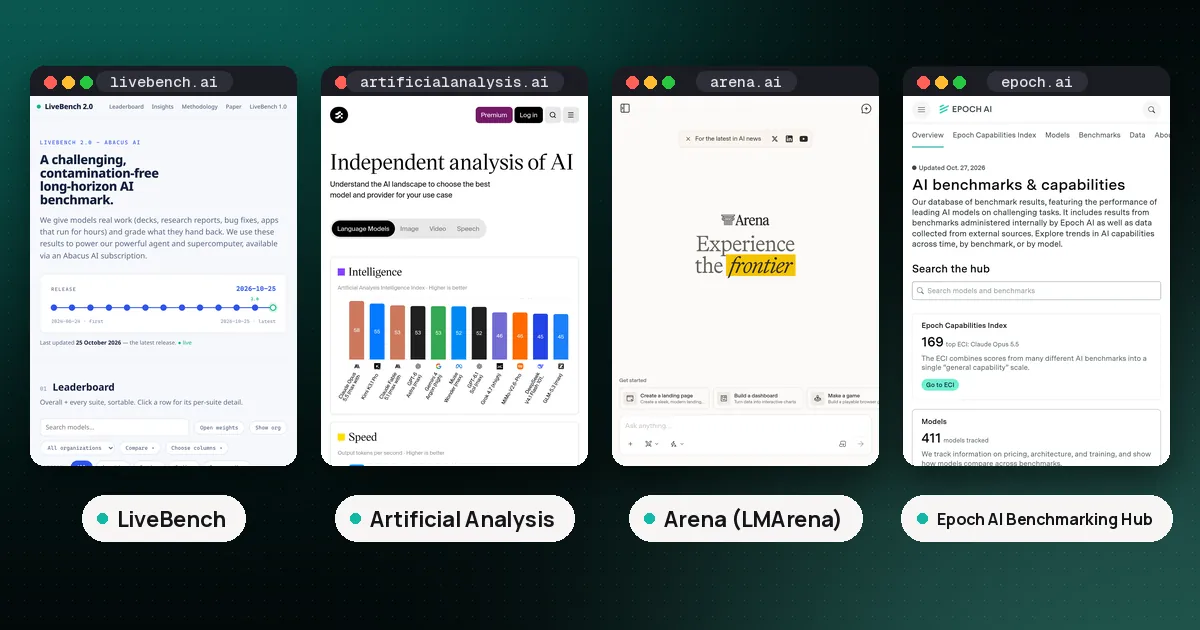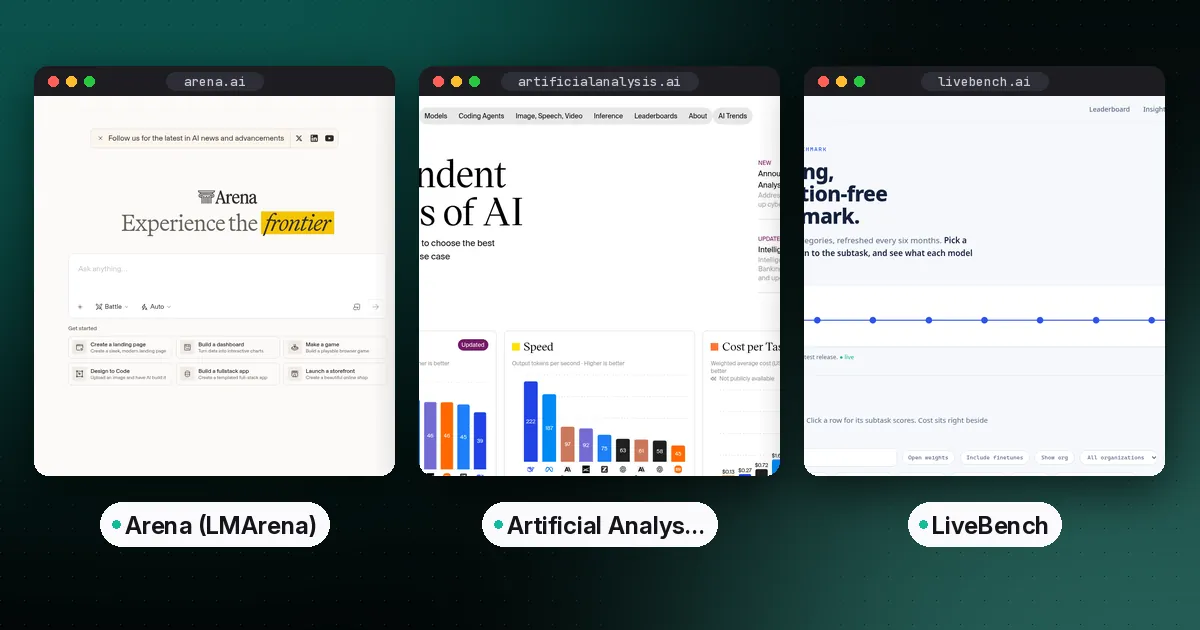
No single LLM leaderboard is best, because each one measures something different. Arena ranks models by millions of human votes on which answer people prefer; Artificial Analysis and the Epoch AI hub run standardized benchmark suites themselves; LiveBench refreshes its questions to limit memorization; and Scale's SEAL leaderboards use private, expert built test sets. Use a preference board to judge style and helpfulness, a benchmark aggregator to judge raw capability, and a specialist board for tasks like coding, tool calling or embeddings. For one of the work task tests these indexes now use, see GDPval benchmark explained.
This guide explains how each leaderboard produces its numbers and where each can mislead you. It does not tell you which model is currently on top, since that changes weekly and every board below shows it live.
How an LLM leaderboard produces its rankings
There are three basic methods, and knowing which one a board uses tells you most of what you need to know about it.
- Human preference: real users submit prompts, see two anonymous answers and vote for the better one. Votes are turned into ratings with a statistical model. This captures what people like, including tone and formatting, but not whether a long technical answer is actually correct.
- Benchmark aggregation: the operator runs a fixed suite of benchmarks on every model under the same settings and combines the results into an index. This is reproducible and objective but inherits every weakness of the underlying benchmarks, which we cover in our guide to LLM benchmarks.
- Private or refreshed test sets: questions are kept secret or replaced regularly so that models cannot have seen them in training. This limits contamination but makes results harder to audit from outside.
The major leaderboards compared
| Leaderboard | Method | What it covers | Main caveat |
|---|---|---|---|
| Arena (formerly LMArena) | Anonymous pairwise human votes | Text, coding, vision, image, video, search, agents | Preference, not correctness; can be gamed by private testing |
| Artificial Analysis | Runs its own benchmark suite; also speed and price | Intelligence Index v5 of 9 evaluations | Mostly English and text; index weights are a choice |
| LiveBench | Fresh questions with objective answers | Math, coding, reasoning, language, data analysis | Smaller question pools per category |
| SEAL by Scale | Private expert built datasets | 20+ benchmarks, including agentic and frontier tests | Scale also sells training data to labs |
| Epoch AI Benchmarking Hub | Runs and collects benchmark results | Epoch Capabilities Index, FrontierMath and more | Some benchmarks have funding ties, which Epoch discloses |
| Vellum | Curated benchmark results | Recent, nonsaturated benchmarks only | Compiles reported numbers rather than testing everything itself |
| Specialist boards | Task specific tests | Aider for code editing, BFCL for tool calls, MTEB for embeddings | Narrow by design |
In prose: Arena is the only major board built on human votes; Artificial Analysis, Epoch AI and LiveBench all run evaluations themselves with published methods; SEAL keeps its tests private; Vellum filters out saturated benchmarks; and the specialist boards are the right place to look when you have one specific task.
Arena (formerly LMArena)
How does LMArena work? You type a prompt, two anonymous models answer, and you vote for the better one, call it a tie, or mark both as bad. Only votes cast while the model names are hidden count. The votes are fitted with a Bradley-Terry model, which estimates each model's probability of beating each other model, and a style control adjustment reduces the advantage of longer or more heavily formatted answers. LMArena renamed itself Arena in January 2026 and moved to arena.ai (announcement). The Arena leaderboard now has separate boards for text, web development, vision, document, search, image generation, image editing, video and agents.
Arena's strength is scale and realism: it reflects what many people actually ask. Its weaknesses are well documented. The Leaderboard Illusion paper found that some providers privately tested many model variants before release and published only the best result, and that proprietary models received far more battles than open weight ones (paper). A 2026 MIT study found that removing just two of more than 57,000 votes in one dataset was enough to change the top ranked model (MIT News). Treat small rating gaps as ties and look at the confidence intervals Arena publishes. Its Agent Arena board, for example, listed Gemini 4 Hydrogen fifth with a rank range of 3 to 10 and a preliminary flag; our Gemini 4 Hydrogen benchmarks check compares that with the fixed test boards. Google launched Gemini 4 Neon quoting 1336 and second place; the board dated the same day showed 1,333 and third, as our Gemini 4 Neon benchmarks check notes.
Arena's agent board works differently. On November 18, 2026 Arena replaced its agent rankings with the Agent Arena Index. It does not use head to head votes. It scores models on signals taken from millions of real agent sessions on arena.ai: Task Completion, Praise vs Complaint, Steerability and Bash Reliability, combined into one weighted number (our Agent Arena Index guide recomputes it and finds Bash Reliability counts half as much as each of the others). Six narrower indexes cover work, coding, chat, task outcomes, steering and tool use, and a separate Alignment Index counts unauthorized actions, false attributions and deceptive completions. Scores are now anchored to a fixed set of established models, so a model's number should not fall just because the field average rises, and the old Tool Hallucination signal was retired (changelog).
Artificial Analysis
Artificial Analysis runs every model through the same benchmark suite under identical prompts and settings and combines the results into the Artificial Analysis Intelligence Index. Version 5, released October 27, 2026 and now at point release v5.0.1, combines nine evaluations in four groups (knowledge work, coding, science and general knowledge) at 25 percent each. It includes tests such as FrontierCode 2.0, Terminal-Bench 4.0, Terminal-Bench-Science, AA-Omniscience and HLE-Diamond, and 60 percent of it rests on private test sets (methodology). Scores from v5 do not compare with v4 scores; our Artificial Analysis Intelligence Index v5 guide explains what changed. It also measures output speed, latency and price per token, which makes it the most practical board for cost and performance tradeoffs. Its Coding Agent Index now includes Cognition's merge focused test, explained in our FrontierCode benchmark guide.
The caveats: the weights are an editorial choice, the suite is mostly text and English, and the index changes version as benchmarks are swapped, so compare scores only within the same version.
LiveBench
LiveBench, launched in 2024, was designed against contamination. It adds new questions regularly, draws on recent sources, and scores every answer against an objective ground truth rather than an LLM judge; its authors note that LLM judges can make large errors on hard questions (paper). It is a good cross check when a model looks suspiciously strong on older public benchmarks. LiveBench relaunched as LiveBench 2.0 in October 2026 with longer, real work suites, and our LiveBench vs Artificial Analysis guide covers how the new version scores and ranks models.
SEAL leaderboards
Scale's SEAL leaderboards use private datasets built by domain experts, covering more than 20 benchmarks including agentic tasks and Humanity's Last Exam, which Scale helped create. The HLE authors now also publish HLE Diamond, a cleaned 1,000 question subset. Keeping tests private makes them hard to train on. The tradeoff is that outsiders cannot inspect the questions, and Scale also sells data services to model developers, so read its results alongside independent boards.
Epoch AI Benchmarking Hub and Vellum
The Epoch AI Benchmarking Hub runs and compiles benchmark results and publishes the Epoch Capabilities Index, plus research on trends in compute and capability. Epoch disclosed that OpenAI funded its FrontierMath benchmark and keeps a holdout set to limit any advantage. The Vellum leaderboard is a clean summary view that deliberately leaves out saturated benchmarks such as MMLU, which makes it useful for a quick look but less useful for methodology.
A newer kind of site combines the boards instead of running tests. BenchLeader collects published results from dozens of evaluators each day, matches the names each one uses for the same model, and ranks them in one index. Its useful extra is that it shows how much the sources disagree, as a range around each score, so you can see when several models are effectively tied.
Specialist leaderboards
When you have a specific job, a narrow board beats a general one. The Aider leaderboards test how well models edit code in real files. The Berkeley Function Calling Leaderboard, now in its fourth version, tests tool and function calls; our guide on which LLM benchmark measures tool calling covers V4 weights, FC versus Prompt rows and related suites. MTEB ranks embedding models across retrieval, clustering and classification tasks, which matters if you are building search or retrieval; pair it with our RAG evaluation metrics guide. Some benchmarks also run their own official boards: the SWE-bench site ranks results on its coding subsets (prefer Scale's SWE-Bench Pro public split over saturated Verified numbers), and the ARC Prize Foundation publishes leaderboards for ARC-AGI, which we set against HLE Diamond in ARC-AGI vs Humanity's Last Exam. If you are unsure whether a knowledge score or a coding score matters for you, read MMLU vs SWE-bench. For job specific boards in one place (legal, tax, customer support, observability and more), see our guide to the Fireworks Specialized Intelligence Index. For scientific image interpretation in life sciences workflows, Artificial Analysis publishes a separate VIALS-AA board. For decision models that return probabilities instead of text, the community Jev Decision Index ranks entrants on private tests only, while the academic SO-Arena benchmark adds tool and web episodes and a separate reliability score.
The Hugging Face Open LLM Leaderboard, once the default for open models, was retired in March 2025, so older articles that cite it are out of date. Its archived results and six benchmarks are still usable, though; our Open LLM Leaderboard v2 guide explains how to read, query and rerun them.
How to use leaderboards without being misled
- Match the board to the question. Human preference for chat quality, benchmark indexes for reasoning, specialist boards for specific tasks.
- Look at confidence intervals. Models a few points apart are often statistically tied.
- Cross check two different methods. A model that leads on both a preference board and an independent benchmark index is a safer bet than one that leads on only one.
- Check dates and versions. Rankings move weekly, and indexes change composition.
- Shortlist, then test. Take the top few candidates and run them on your own test set, as described in our playbook on how to evaluate LLM apps.
Pros and cons of leaderboards
Pros: free, continuously updated, and a fast way to narrow a long list of models; independent boards are more trustworthy than vendor launch charts.
Cons: each measures a narrow slice; preference boards can be gamed and reward style; benchmark boards inherit contamination and saturation; none know your data, latency budget or failure costs.
Who should use which leaderboard
Developers choosing a model for a product should start with Artificial Analysis for capability, speed and price, then confirm on a specialist board for their task. Teams building chat experiences should weigh Arena's preference data. Researchers and analysts will get the most from Epoch AI and LiveBench, whose methods are open. Anyone building retrieval should check MTEB. Everyone should finish with their own evaluation, using the tools in our guide to LLM evaluation frameworks.
FAQ
Which LLM leaderboard is best?
It depends on what you need. Arena is best for human preference, Artificial Analysis for standardized capability plus speed and price, LiveBench for contamination resistant results, and specialist boards such as Aider, BFCL and MTEB for coding, tool calling and embeddings.
How does LMArena work?
Users compare two anonymous model answers to their own prompt and vote for the better one. Only anonymous votes count, and Arena fits them with a Bradley-Terry model, with a style control adjustment, to produce ratings. LMArena was renamed Arena in January 2026.
Is LMArena reliable?
It is a useful signal of what users prefer, but research has shown that private prerelease testing can inflate scores and that rankings near the top can be fragile. Treat close ratings as ties and confirm with benchmark based boards.
What is the Artificial Analysis Intelligence Index?
It is a composite score from Artificial Analysis that combines nine evaluations, all run under identical settings. The current version, v5.0.1 as of November 8, 2026, puts them in four groups (knowledge work, coding, science and general knowledge) weighted 25 percent each. Inside those groups, AA-Briefcase, FrontierCode 2.0, Terminal-Bench-Science and AA-Omniscience carry 15 percent each. The older v4.3.2 used ten evaluations with different weights, and its scores do not compare with v5.
What happened to the Hugging Face Open LLM Leaderboard?
Hugging Face retired the Open LLM Leaderboard in March 2025, so articles that still cite it are out of date. Independent boards like Artificial Analysis, Epoch AI and LiveBench now fill much of that role.