The code golf benchmark everyone is talking about this week is go/codegolf, a test that asks AI models to write the shortest working program for 32 old Google contest problems in 8 languages. OpenAI's GPT-6.2 Astra leads it with 91.934% overall and is the only model that beats the 2015 human records on the JavaScript, Python and C++ cells (92.265% against 87.533%). Every model with a complete run solves all 256 cells, so the ranking measures how far each one can shrink code that already works, not whether it can solve the task.
This guide explains where the problems come from, how the squared byte score works, what the current leaderboard says, and where the numbers are thinner than the headline. If you want benchmarks that test real software work instead, start with our coding agent benchmark rankings.
What the go/codegolf benchmark is
The benchmark was built by a former Googler who posts as @binjin and published it at bjin.github.io/go-codegolf-benchmark, with the site code in a GitHub repository. In 2015 Google ran an internal weekly contest called go/codegolf: one problem a week, and the shortest program that passed every test case won. After seven days the scoreboard froze and all code became visible, but anyone could still submit a "challenge" that was strictly shorter than every earlier entry. Those challenge entries are why the human records are hard to beat.
The author kept 32 of those problems, wrote about half of them, and credits the original authors of the rest on the Problems page. The site says the problems appear online there for the first time and that it never shows the human solutions, so there is no public answer key to memorize. A first post about it on Hacker News in September drew 4 points. The November 22 post titled "GPT-6.2 Astra is the first model to beat Googlers' code golf records" reached 397 points and 114 comments (Hacker News thread).
The problems are small puzzles: counting valid IPv4 addresses in a digit string, Game of Life, Nim, Blackjack hands, Cracking Caesar, md5 substring and two parenthesis sequence problems, among others.
How models play: 256 cells and a 30 minute clock
A cell is one problem in one language. There are 32 problems and 8 languages, so 256 cells. The languages are the four the 2015 site supported (JavaScript, Python, C++ and Haskell) plus four golfing favorites with no 2015 human records: Ruby, Raku, Racket and GolfScript, a stack based language with very little public training data. GolfScript runs on the reference interpreter from that repository.
Each cell gets a fresh session with a 30 minute wall clock limit. The model receives the problem statement, the input and output spec, every test case and a short language guide (plus the full reference for GolfScript). It has two tools:
- submit runs a solution against all tests and keeps it only if it is shorter than the model's previous best. Every reply includes the current best known size, so the model always knows a shorter answer exists.
- playground runs any program in the same sandbox, which lets a model test language quirks or write a quick search program to find a magic number.
There is no internet, no shell and no other files. For the four original languages, the sandbox rebuilds the 2015 setup, down to the versions: Rhino 1.7R4 for early JavaScript problems, PyPy 2.3.1 (Python 2.7.6), clang 3.5.0 and GHC 7.8.4. A trick that worked in 2015 still works; a feature added later does not. Primality and factorization builtins are removed in C++, Ruby, Raku and Racket so prime problems stay hard. The author notes that one AI model found a way to switch off a clang error flag from inside its own C++ solution to use a shorthand the original site rejected. No Googler ever did that.
How the score works
Each cell is scored as (best known size ÷ your size) squared. Matching the best known size gives 100%. A solution 10% longer gets 82.6%, one twice as long gets 25%, and an unsolved cell gets 0. The squaring rewards every saved byte near the top.
The leaderboard reports two summary numbers:
- Overall averages all 256 cells.
- JS/PY/C++ averages the 96 JavaScript, Python and C++ cells, the languages where the 2015 records had real competition.
Haskell is left out of the human comparison on purpose. Only a few regulars golfed in it, and models have already beaten 31 of the 32 Haskell records, which we confirmed in the data file. Haskell still counts in every model's Overall score.
The best known size can come from a human, a model or an "oracle": a model given internet access, no time limit and every solution in the benchmark, including the hidden human ones. The first oracle was GPT-6 Astra. The oracle is unranked, but its byte counts set the target. In 126 of the 256 cells the oracle's solution is shorter than every competitor's, so even a perfect field could not reach 100% today. Because any shorter solution lowers everyone else's score in that cell, the numbers move as new models arrive.
Code golf benchmark leaderboard (November 26, 2026)
These are the top 10 of 22 complete model runs in the data file we downloaded on November 26, sorted by Overall. Effort is the reasoning setting each run used.
| Rank | Model (effort) | Released | Overall | JS/PY/C++ |
|---|---|---|---|---|
| 1 | GPT-6.2 Astra (max) | Nov 17 | 91.934% | 92.265% |
| 2 | Gemini 4 Neon (xhigh) | Nov 18 | 87.280% | 86.549% |
| 3 | Claude Fable 5.2 (xhigh) | Nov 9 | 86.611% | 86.634% |
| 4 | Gemini 4 Carbon (high) | Nov 10 | 85.894% | 85.122% |
| 5 | GPT-6.2 Sol (max) | Nov 17 | 85.599% | 86.211% |
| 6 | Gemini 4 Argon (high) | Oct 13 | 84.598% | 84.827% |
| 7 | Claude Opus 5.5 (xhigh) | Sep 22 | 83.567% | 83.516% |
| 8 | GPT-6 Astra (max) | Sep 4 | 79.917% | 79.466% |
| 9 | GPT-6.1 Terra (max) | Oct 26 | 78.875% | 78.541% |
| 10 | Claude Sonnet 5.5 (xhigh) | Sep 28 | 76.638% | 77.248% |
Humans score 87.533% on JS/PY/C++ and have no Overall score, since there are no 2015 records in four of the languages. That puts them between GPT-6.2 Astra and everyone else on the cells that matter for the comparison. Claude Fable 5.2 is the closest challenger on those cells at 86.634%, about 0.9 points short.
Overall scores across all complete runs range from 47.975% (GPT-6 Luna) to 91.934%. Gemini 4 Neon is second on Overall but third on JS/PY/C++, a reminder that the two numbers rank models differently. For how Neon's other launch numbers hold up, see our Gemini 4 Neon benchmarks check.
Where GPT-6.2 Astra beats the human records
Astra leads every one of the eight languages in the data, not just the headline three. Against humans on the original languages:
| Language | Humans | GPT-6.2 Astra | Cells humans still hold |
|---|---|---|---|
| JavaScript | 80.980% | 90.555% | 4 of 32 |
| Python | 90.579% | 93.049% | 5 of 32 |
| C++ | 91.039% | 93.190% | 5 of 32 |
| JS/PY/C++ | 87.533% | 92.265% | 14 of 96 |
"Cells humans still hold" means the human solution is shorter than every model's. Across the 96 JS/PY/C++ cells, some model has beaten the human record in 62 and humans still hold 14. The rest are ties. Astra itself matches the best known size in 92 of the 256 cells.
The biggest gap is JavaScript, where the human records are weakest (80.980%). In Python and C++ the margin is only 2 to 3 points, and the human records are combined best efforts from a week of competition plus later challenges, not one person working for 30 minutes.
Why reasoning effort matters on a 30 minute clock
Thinking time comes out of the same 30 minutes as testing and submitting, and only submitted code counts. The author runs each model at its highest setting unless that setting tends to think until time runs out, in which case it runs at xhigh. Some commenters on Hacker News questioned running Astra at max while several Claude models ran at xhigh, so this rule is worth knowing before you compare rows.
The author's own test shows why. Claude Haiku 5.5 at max produced the shorter solution in 160 cells and the longer one in 52 compared with its xhigh run, and scored higher overall (61.832% against 56.796%). But in some cells the max run spent so long thinking that it ended with little more than its first working draft. Taking the shorter of the two runs in each cell gives 64.140% overall and 65.836% on JS/PY/C++, better than either run. We recomputed those two combined figures from the data file and they match.
The author also reports that GPT-6 Sol usually stops after 5 to 10 minutes even at its highest effort, while GPT-5 models keep working to the limit on most cells, and suspects that explains much of GPT-6 Sol's low rank (58.487% overall).
What the code golf benchmark does and does not tell you
The benchmark measures something most coding tests do not: whether a model keeps finding better ideas after it already has a passing answer. There is no LLM judge and no style score. A program passes or it does not, and then its bytes are counted. That makes the results exact and easy to check, which is why we could rebuild every score.
The limits are just as clear:
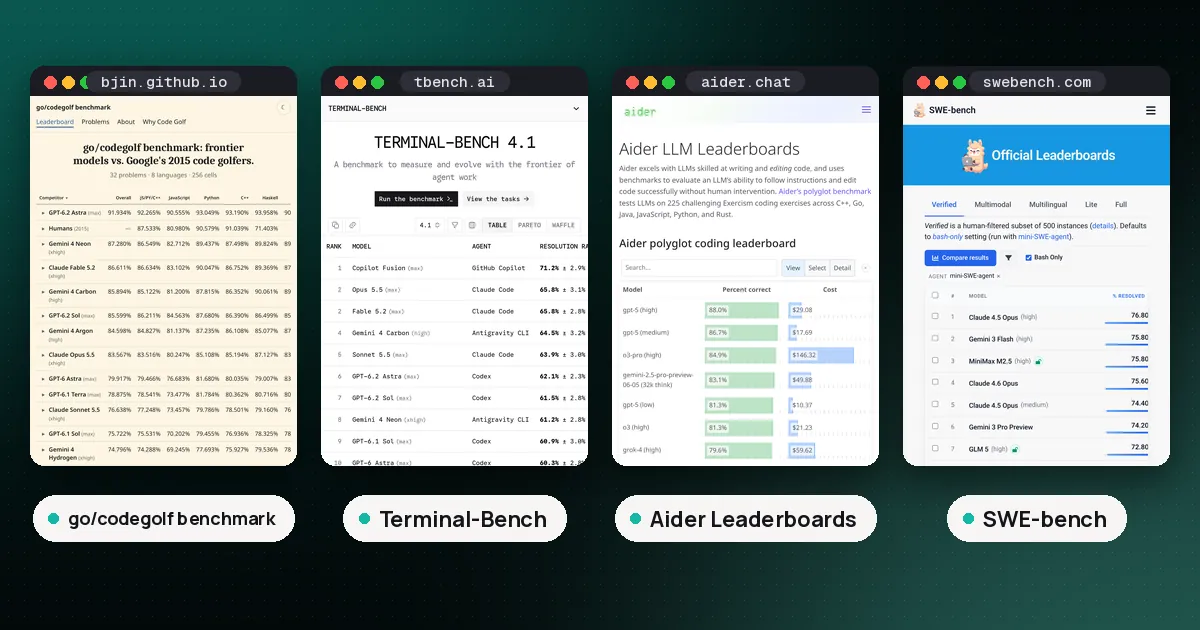
- It is not about useful code. Golfed programs are deliberately unreadable. A high score says nothing about writing maintainable software, fixing a real repository or running a terminal task. For that, look at SWE-bench, Terminal-Bench or the Aider leaderboards.
- One maintainer, one harness. The site is a personal project, not a peer reviewed paper, and the problems, sandbox and effort choices come from one person.
- Moving targets. Scores drop whenever anyone finds a shorter solution, so compare rows from the same data snapshot, not numbers copied on different days.
- Hidden human answers. Keeping the human code private protects the test from memorization, but it also means outsiders cannot verify the human byte counts themselves.
Used as one signal among many, it is a fresh, hard to game way to compare frontier models on persistence and creative search. Our guide to LLM leaderboards compared shows where it fits next to the broad boards.
How to read the board yourself
Pick a competitor on the leaderboard to see a heatmap of its score in every problem and language. Each problem page has a full scoreboard, and clicking a model's cell shows its solution code (human code and oracle code stay hidden). The leaderboard and problem data are in one JSON data file the page loads, so you can check any score with the formula above. If you are new to reading benchmark tables, our explainer on what LLM benchmarks measure is a good start.
FAQ
What is the go/codegolf benchmark?
It is a public benchmark of 32 problems from Google's 2015 internal code golf contest, played in 8 languages. Each model gets 30 minutes per problem and language to write the shortest program that passes every test, and scores depend on byte count against the best known solution.
Which model leads the code golf benchmark?
GPT-6.2 Astra at max effort, with 91.934% overall and 92.265% on JavaScript, Python and C++ in the November 26, 2026 data. It is the only model above the human records (87.533%) on those three languages. Gemini 4 Neon is second overall at 87.280%.
Did AI really beat Google's human code golfers?
On the combined JavaScript, Python and C++ score, yes, but only one model so far. Humans still hold 14 of those 96 cells outright, and the human records are the best entries from a whole week of competition and later challenges.
Why is the score squared?
Squaring the ratio of best known size to your size makes small savings near the top count more. A solution 10% longer than the best scores 82.6%, and one twice as long scores 25%.
Can I see the AI solutions?
Yes. Clicking a model's cell on the heatmap or on a problem scoreboard shows its code. The human solutions and the oracle's solutions are not published.