An AI music detector is software that listens to a track and estimates whether a generator such as Suno or Udio made it, usually by spotting audio artifacts people cannot hear. They work well on songs from generators they were trained on, and that is why Tidal is using one to remove wholly AI generated tracks from December 9, 2026. They are weaker on short clips, edited audio and new generators. In our own test, a free open source detector caught all 21 AI songs we gave it but also flagged 2 of 11 human recordings, both under a minute long.
This guide covers how detection works, which detectors Tidal, Deezer and Spotify rely on, what the accuracy claims mean, what we found when we ran one ourselves, and a practical routine for checking a single song.
Why AI music detection is in the news
On November 24, 2026, Tidal announced that it will reject and remove "any wholly AI generated track" starting December 9 (Tidal AI Policy). Robert Andersen, who leads Tidal at Block, said 43% of tracks delivered to Tidal in the previous 90 days were detected as AI generated, that 96% of those songs get zero plays, and that the change removes about 29 million tracks and will reject 80,000 to 85,000 songs a day (The Verge). The Hacker News thread on the ban reached 337 points, and one of the most common questions in it was simply how Tidal plans to tell.
The answer is a commercial detector. Tidal named Ircam Amplify, the commercial arm of the French research institute IRCAM, as its detection partner, and it will also reject deliveries whose metadata says the track was made only with AI tools (Music Business Worldwide). Songs that were assisted by AI but are not the sole output of a generator stay on the platform.
How an AI music detector works
There are three broad ways to tell whether a song came from a generator, and they fail in different ways.
Classifiers that read the audio. This is what Tidal, Deezer and most "AI song checker" sites use. A model trained on real songs and generator output learns the traces generators leave behind. Deezer says its tool "identifies specific audio artefacts and signatures associated with generative AI models" that are "generally inaudible to listeners" (Deezer newsroom). Deezer's researchers showed in a January 2025 paper that such a classifier is surprisingly easy to train to 99.8% test accuracy, then warned that a good test score "is not the end of the story" because of two open problems: robustness to audio manipulation and generalization to models the detector has never seen (arXiv 2501.10111).
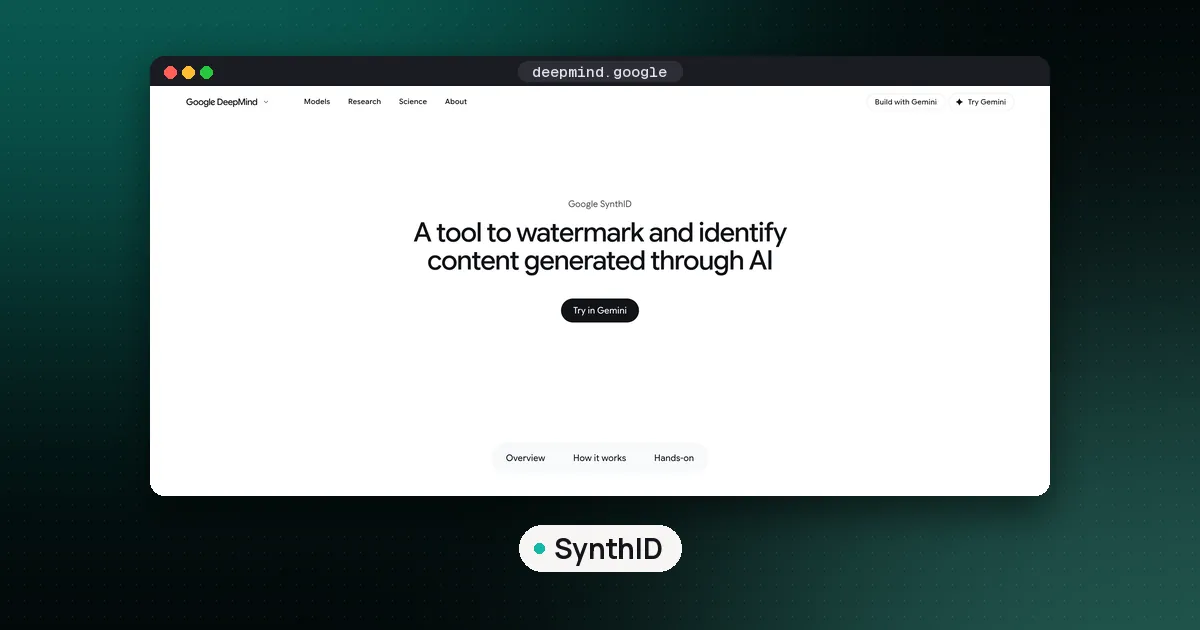
Watermarks. Some generators hide a signal in the audio. Google says every track from its Lyria music model is watermarked with SynthID, which it describes as inaudible and resistant to added noise, MP3 compression and speed changes (Google DeepMind). A watermark is strong evidence when present, but only the generator's owner can read it, and a missing watermark tells you nothing about Suno or Udio. Our SynthID Detector guide explains how to upload audio for a check.
Metadata and behavior. Distributors can declare AI use, and platforms can watch how tracks arrive and get streamed. Spotify says no single signal catches slop or spam, so it combines listener engagement and feedback, upload patterns, metadata and "multiple third party AI detection tools" (Spotify). Provenance data such as Content Credentials belongs in this group too: useful when it exists, silent when stripped.
The detectors streaming services use
| Service | Detector | What it does with AI tracks | Published accuracy claim |
|---|---|---|---|
| Tidal | Ircam Amplify plus metadata checks | Labels and demonetizes now; removes wholly AI tracks from Dec 9, 2026 | Ircam: 99% accuracy, under 0.02% false positives |
| Deezer | Its own tool, in use since January 2025 | Tags albums, excludes from recommendations, demonetizes fraudulent streams | 99.8% accuracy; misses about 2 in 1,000 AI tracks |
| Spotify | Several third party tools plus behavior signals | Removes slop and spam from recommendations; AI Persona badges | No accuracy figure published |
Ircam Amplify. Its product page calls the AI Music Detector "the world's most accurate solution," claims 99% accuracy and less than 0.02% false positives, lists Suno, Udio, Sonauto and ElevenLabs among the generators it covers, and says it can scan more than 250,000 tracks in an hour depending on server capacity (Ircam Amplify). Ircam Amplify sells through an API and SDK to streaming services, distributors, labels and rights societies, and access is by request. Pitchfork reported a different figure, a 1% false positive rate, and asked Tidal about wrongly flagged artists. A spokesperson answered that "false positives are an inherent risk of enforcing this policy" and that artists can appeal (Pitchfork).
Deezer. Deezer launched its detector in January 2025 and has licensed it to other companies since January 2026, starting with the French rights society Sacem (Deezer newsroom). Its FAQ, updated with July 2026 data, says it was receiving nearly 90,000 fully AI generated tracks a day, with the share passing 50% of daily uploads at its June peak. It claims 99.8% accuracy, missing about two AI tracks in every 1,000 and wrongly flagging fewer than one human track in every 10,000. It applies the visible tag at album level to reduce wrong labels, and it targets fully AI generated music rather than AI assisted work.
Spotify. Spotify does not remove AI music as a category. It says it has taken more than 50 million slop and spam tracks out of recommendations in 2026, removed more than 75 million spammy tracks outright, and found that tracks with a high probability of being AI generated are 10 times more likely to fall below its 1,000 stream royalty threshold.
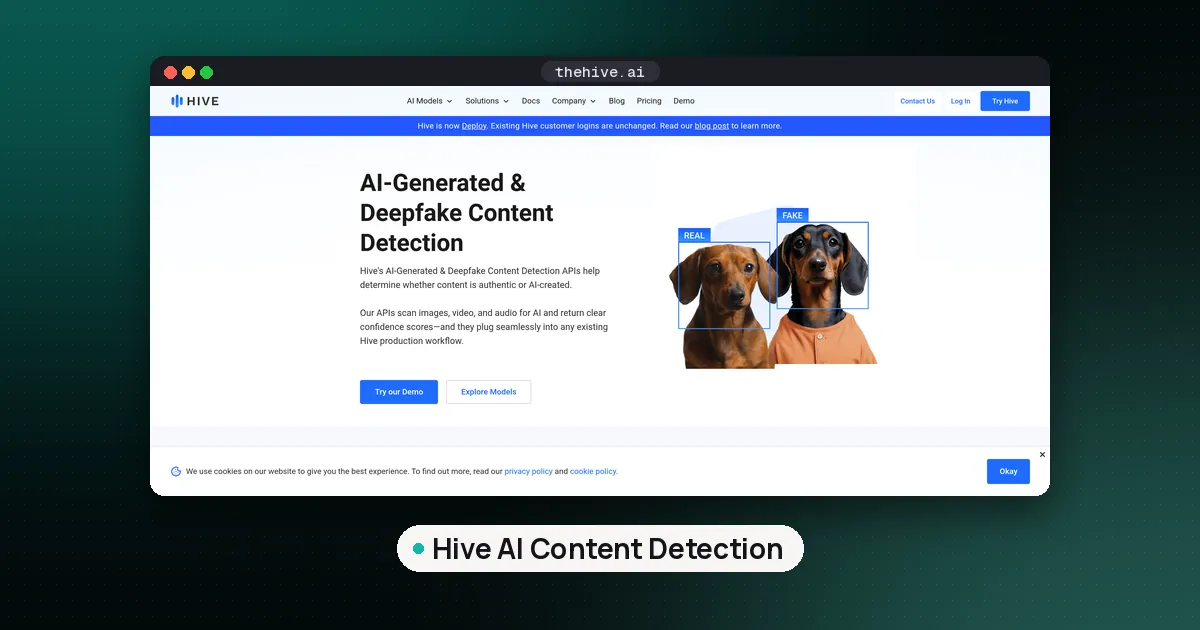
Hive. For businesses that want an API rather than a streaming platform's judgment, Hive sells a music model that checks the track and vocals in one response. Our deepfake detection guide covers Hive's other models.
Are AI music detectors accurate?
The vendor numbers above come from the vendors. None of the three services has published an independent audit, and accuracy depends on what you test with. Two things make the headline numbers less useful for judging one song.
First, base rates matter. A false positive rate that sounds tiny still adds up across a catalog of hundreds of millions of tracks, which is why Deezer tags at album level and Tidal says it acts only on wholly AI generated recordings "to avoid false positives."
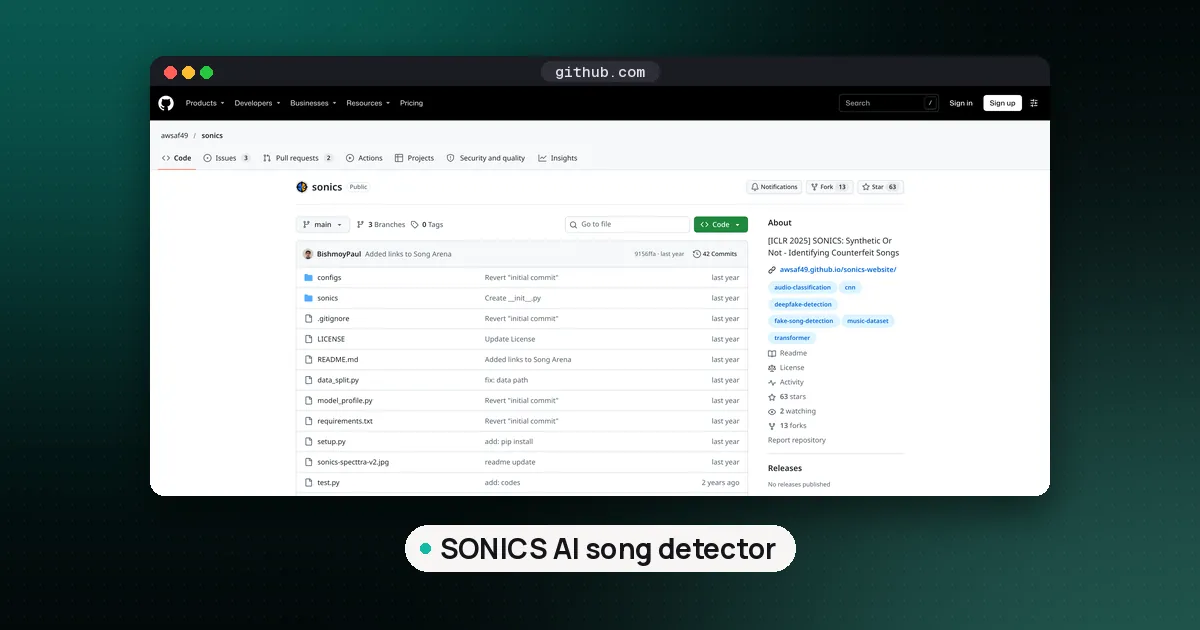
Second, a detector is tuned to the generators it has seen. The open SONICS research project, which built a dataset of over 97,000 songs including more than 49,000 synthetic songs from Suno and Udio, reports very different results by model (arXiv 2408.14080). Its model card lists an F1 score of 0.97 for the version that reads 120 seconds of audio, with 0.96 sensitivity and 0.99 specificity, against 0.76 F1 for the version that reads only 5 seconds (Hugging Face). Context length matters a lot. For text detectors the same pattern shows up, as our guide on whether AI detectors are accurate explains.
What our own test found
We wanted to see the problems the research warns about with our own files, so on November 27 we ran the free SONICS detector on an ordinary CPU with no GPU. It is MIT licensed and available on GitHub. We used two of its six published models: the 120 second alpha model and the 5 second gamma model. The AI songs were 20 tracks from the SONICS test split (12 Suno, 8 Udio, all made with 2024 generator versions) plus the project's example fake. The human songs were 10 Creative Commons or public domain recordings from Wikimedia Commons, from a 1924 Vernon Dalhart record to a 2022 indie folk track, plus the project's example real song. Anything scoring 0.5 or higher counted as "AI."
| Model | AI songs caught | Human songs wrongly flagged |
|---|---|---|
| 120 second model | 21 of 21 | 2 of 11 |
| 5 second model | 16 of 21 | 3 of 11 |
Three findings stood out.
Short clips confuse the long model. Both human songs the 120 second model flagged were short: a 60 second clip scored 0.87 and a 33 second clip scored 0.96. The model pads anything under two minutes with silence. Every human recording longer than two minutes scored 0.35 or lower. We cannot prove why from 11 files, but a 30 second snippet is a poor input for this model.
The short model misses Udio. The 5 second model caught 11 of 12 Suno tracks but only 4 of 8 Udio tracks. It also flagged three human songs, two of them full length recordings from 2004 and 2006.
Simple edits fool it. We then edited each AI song five ways and scored all 105 copies again. Raising the pitch by two semitones (tempo kept) dropped the 5 second model from 16 of 21 caught to 0 of 21. A 6 kHz low pass filter, which removes the highest frequencies, cut it to 13 of 21. The 120 second model held up better: it still caught 20 of 21 after the pitch shift, 18 of 21 after the low pass filter, and all 21 after MP3 compression at 64 kbps, a 6 percent speedup and added pink noise.
This was a small test with older generator versions, so treat it as an illustration, not a ranking. It does match the warning in Deezer's paper: a detector can score well on clean test data and still be easy to push around.
How to tell if a song is AI generated
For one song, combine signals instead of trusting any single score.
- Check the platform's own label. On Deezer, look for the AI tag on the album. On Tidal, wholly AI tracks are labeled, and you can turn off AI labeled recordings in Settings so they stop playing. On Spotify, look for an AI Persona badge on the artist profile and the AI Credits that artists disclose in Song Credits on the Now Playing view in the mobile app.
- Look at the artist, not just the track. Spotify lists the tactics it hunts for: mass uploads, duplicates, SEO manipulation, spammy playlist networks and artificially short tracks. An "artist" with hundreds of releases in a few months, no live dates and no verified profile deserves suspicion. A Verified by Spotify badge means a real, identifiable person is behind the profile.
- Run a full length file through a detector. Use the whole track, not a clip, and the original file rather than a screen recording. The free SONICS demo on Hugging Face accepts an upload and returns a real or fake probability. Our test suggests choosing its 120 second model.
- Check for a watermark when Google might be involved. Upload the audio to SynthID Detector. A positive result is strong evidence of Lyria. A negative result says nothing about other generators.
- Treat a score as a lead, not a verdict. If you are an artist who was wrongly flagged, Tidal's policy page lists an appeal path through its support form ("This track was wrongly tagged as AI"), and Spotify lets badged artists appeal an AI Persona label.
If the question is about a video rather than a song, see our guide on how to check if a video is AI generated.
Limits to keep in mind
AI assisted music is out of scope. Tidal, Deezer and Spotify all focus on wholly generated tracks. Tidal's policy says plainly that partly AI generated songs may remain unlabeled, and it takes no action on AI written compositions. A song with human vocals over a generated backing track may pass every detector.
New generators arrive faster than training data. Deezer says it can add a generator when it has relevant examples, and Ircam says it stays up to date. A brand new model can still slip through until the detector learns it.
Scores are not proof. Every tool here returns a probability. For an introduction to how these systems estimate probabilities across text, images and audio, see what is AI detection.
FAQ
Is there a free AI music detector?
Yes. The SONICS models are open source under the MIT license, and a free demo on Hugging Face lets you upload a song. SynthID Detector is free for checking Lyria watermarks. Commercial tools from Ircam Amplify, Deezer and Hive are sold to businesses.
How does Tidal detect AI music?
Tidal uses Ircam Amplify's detector, which analyzes the audio signal, plus metadata checks that reject deliveries declared as made only with AI tools. From December 9, 2026 it removes tracks it determines are wholly AI generated, and artists can appeal through Tidal's support form.
Can Spotify detect AI music?
Spotify combines several third party AI detection tools with listener behavior, upload patterns and metadata. It labels AI generated artist identities with an AI Persona badge and keeps them out of recommendations by default, but it does not remove AI music as a category.
Can you trick an AI music detector?
Sometimes. Deezer's own researchers flagged robustness to audio manipulation as an open problem. In our test, raising the pitch two semitones made the 5 second SONICS model miss all 21 AI songs, while the 120 second model still caught 20.
How accurate are AI music detectors?
Vendors claim 99% (Ircam Amplify) and 99.8% (Deezer), but neither figure has been independently audited. Open research models score far lower on short clips. Expect good results on full songs from known generators and weaker results on clips, edits and new models.