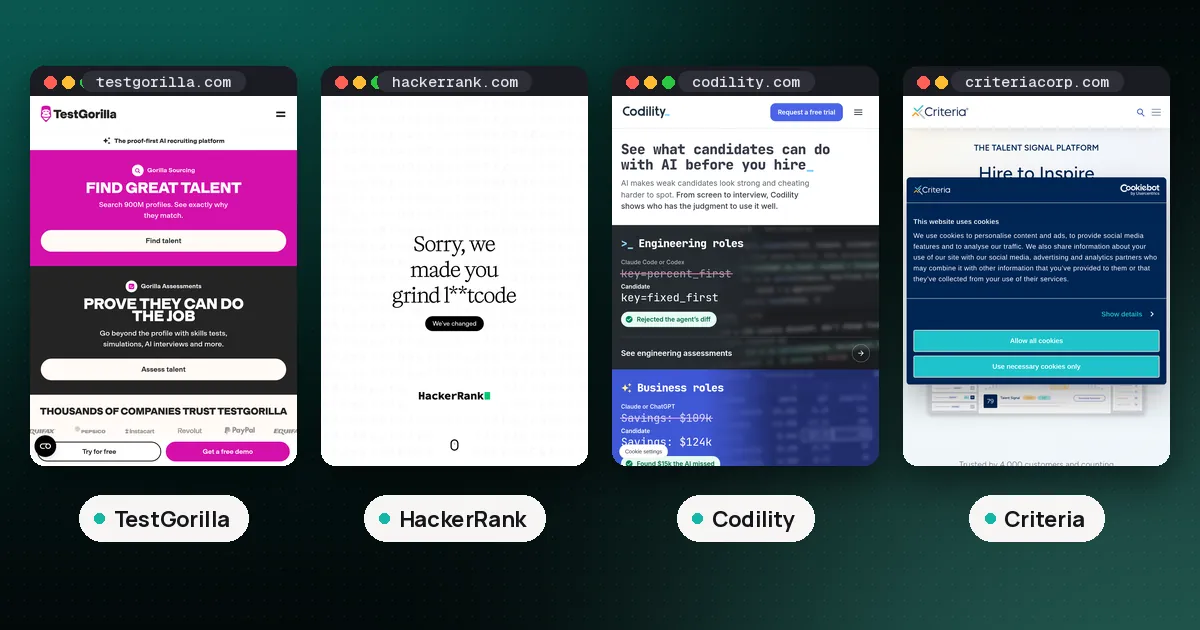
TestGorilla vs HackerRank comes down to who you are hiring. Pick TestGorilla when you screen many kinds of roles and want short tests of cognitive ability, personality, language and job skills in one assessment, with a free plan and published prices. Pick HackerRank when you hire software engineers and need deep coding work: multifile projects, an agentic IDE where candidates can work with Claude, Gemini or GPT, live pair programming and an AI interviewer. A company that hires developers and nondevelopers often ends up with both, or with TestGorilla plus a structured interview.
The two products get compared because both sell "skills tests", but they measure different things. TestGorilla mostly sells short multiple choice tests across hundreds of skills. HackerRank sells realistic engineering work samples. The rest of this guide lays out what each one tests, what it costs per candidate as of October 29, 2026, how each handles AI tools and cheating, and what the hiring research says about which kind of test predicts job performance. We read both vendors' pricing and product pages on that date; we did not run a paid hiring round on either platform.
TestGorilla vs HackerRank at a glance
| Item | TestGorilla | HackerRank |
|---|---|---|
| Built for | Screening for many roles | Technical hiring (developers) |
| Main test format | Short multiple choice skills tests, plus video questions, AI interviews and some coding tests | Coding questions, multifile projects, live pair programming, AI interviewer |
| Library size | 350+ tests on paid plans | 2,000+ questions on Starter, 4,000+ on Pro, 7,500+ on Enterprise |
| Free option | Free plan: 10 credits a month, 5 essential tests with unlimited use | Free account to try the product; no ongoing free plan listed |
| Entry price | Core from $215 a month per account, billed annually | Starter $79 a month ($948 billed annually) |
| Pricing unit | Credits, charged when a candidate starts | Candidate attempts |
| AI use by candidates | Tests measure skills; AI interviews are a question format | Candidates can pick Claude, Gemini or GPT inside tasks, with guarded or unguarded settings |
Prices and limits come from the TestGorilla pricing page and the HackerRank pricing page, both read on October 29, 2026. Both companies changed their plans within the past year, so check again before you budget.
What TestGorilla tests
TestGorilla's test library is organized by skill category: cognitive ability, language, personality and culture, programming skills, role specific skills, situational judgment, software skills and typing speed. Most tests are multiple choice and take about 10 minutes. Examples include Problem Solving (9 minutes), Critical Thinking (12 minutes), Abstract Reasoning, Numerical Reasoning, Verbal Reasoning, a Rapid Cognitive Index, the Big 5 (OCEAN) personality test, CEFR level language tests such as English C1, and software tests for Excel, Salesforce or QuickBooks.
An assessment usually combines several of these. A support hire might take a cognitive test, an English test and a Zendesk test in one sitting: a broad, quick read on a candidate for almost any job.
TestGorilla does have programming content. Most of it is multiple choice knowledge tests (React, Django, Kubernetes, Git, SQL Server and many more). There is also a smaller set of hands on coding tests that run about 35 minutes each: data structure tests on arrays, strings, linked lists, trees, graphs and hash tables, entry and intermediate level algorithms, a debugging test and SQLite query tests. The pricing page lists a built in coding IDE, code playback, automated scoring, and algorithmic, debugging and language specific challenges. Custom coding challenges are on the Plus plan only.
So TestGorilla can check that a junior developer can write a working function. It is not built to watch a senior engineer find a bug in a real codebase.
What HackerRank tests
HackerRank is a developer hiring platform from end to end. Every plan on its pricing page includes three products: Screen (take home assessments), Interview (live pair programming) and Chakra, which HackerRank calls an AI interviewer. Chakra runs a conversational screen with real time follow up questions and produces a report with a transcript, session replay and scores.
The question library covers 55+ languages. Every plan includes a full IDE with a terminal and file navigation, multifile project questions, real world questions and custom questions. The HackerRank FAQ says the full library has 7,500+ coding, multiple choice, database, whiteboard, written and project questions.
The biggest difference in 2026 is how HackerRank treats AI. Its plans include an "Agentic IDE (work alongside AI agents)", candidate model selection between Claude, Gemini and GPT, and guardrail controls that set a task to guarded or unguarded. In plain terms, you can let a candidate use an AI model during the test and then grade how well they planned, prompted and checked its work. That is a closer copy of a modern engineering job than a timed puzzle with every outside tool banned.
If you are the candidate rather than the employer, our guide on how to take a coding test covers HackerRank's scoring rules, hidden test cases and what happens when the timer runs out.
TestGorilla pricing vs HackerRank pricing
Both vendors now publish prices, which makes a fair comparison possible. Here is what each page showed on October 29, 2026.
TestGorilla (Gorilla Assessments, priced per account):
- Free: 10 credits a month that refresh monthly, five essential tests with unlimited use (Problem Solving, Communication, Time Management, Big 5 (OCEAN) and Motivation), limited use of 180+ other tests, resume scoring and qualifying questions.
- Core: from $215 a month per account, billed annually. Full library of 350+ tests, video questions from the TestGorilla library, custom questions and a shared credit pool.
- Plus: from $520 a month per account, billed annually. Adds 100+ AI interviews, custom AI interviews, job simulations, custom tests and coding challenges, ID verification, ATS and API integrations and removal of TestGorilla branding.
Credits are the unit that matters. Each skills test costs 1 credit per candidate, video questions cost 1, an AI interview costs 2 and ID verification costs 1. Resume scoring, qualifying questions and custom questions are free. Credits are charged when a candidate starts the assessment, not when you send the invite, and costs stack: an assessment with three skills tests costs 3 credits for every candidate who starts it. The page shows prices "from" a figure because the credit allowance changes with the tier you choose, so you need the checkout page to see exactly how many credits $215 buys.
HackerRank (priced per plan, unlimited users on Starter and Pro):
- Starter: $79 a month, $948 billed annually, 60 candidate attempts a year, 2,000+ library questions, Chakra, Screen and Interview, advanced proctoring and the agentic IDE.
- Pro: $419 a month, $5,028 billed annually, 360 candidate attempts a year, 4,000+ questions, plus Greenhouse, Lever and Ashby ATS integrations and Gmail and Outlook calendar integrations.
- Enterprise: custom pricing, with custom attempts, certified assessments for 80 roles, leaked question protection, API and MCP access, the desktop app, SSO and 22+ ATS integrations.
Extra attempts cost $20 each on Starter and Pro, and annual Pro customers can buy extra attempts ahead of time at $15. HackerRank labels annual billing "Save 20% annually".
Cost per candidate, worked out
HackerRank's numbers divide cleanly. If you use every attempt you paid for, Starter works out to $948 / 60 = $15.80 per candidate and Pro to $5,028 / 360 = about $13.97. If you only use half your attempts, those figures double. Plan on the hires you will really make, not the plan you hope to grow into.
TestGorilla cannot be worked out the same way from the public page, because the credit count behind each "from" price is set at checkout. What you can say is that a TestGorilla candidate usually consumes several credits (one per test in the assessment), while a HackerRank candidate consumes one attempt per test invite. If you screen a few hundred nontechnical applicants a year with a five minute look at each, TestGorilla's free plan or Core plan will usually cost less. If you run 50 developer screens a year, HackerRank Starter is a known $948.
AI tools, cheating and integrity
Both vendors know candidates now have AI tools in another browser tab, and they respond in different ways.
TestGorilla focuses on monitoring. Its pricing page lists a candidate behavior monitor, webcam snapshots, multiple attempt prevention, location logging and large question pools per test, with ID verification on Plus.
HackerRank does both monitoring and design. Every plan has AI powered plagiarism detection, session replay, device and object detection and standardized integrity reports. Its FAQ describes tab and copy paste proctoring, multiple monitor detection and live photo monitoring, plus an AI Proctor Mode that watches activity in real time. On the design side, it lets you allow AI on purpose and grade the result, which removes the incentive to hide it.
If AI fluency is part of the job, HackerRank's approach gives you more signal.
What the research says about which test predicts performance
This is where the comparison gets more useful than a feature table. The best current summary of hiring research is a 2022 meta analysis in the Journal of Applied Psychology by Sackett, Zhang, Berry and Lievens, Revisiting meta analytic estimates of validity in personnel selection. It corrected older estimates that had been inflated and found that most selection methods predict job performance less well than people thought, though they remain useful.
Their revised mean validity estimates (a correlation with later job performance, where higher is better) include:
| Selection method | Estimated validity |
|---|---|
| Structured interviews | .42 |
| Job knowledge tests | .40 |
| Work sample tests | .33 |
| Cognitive ability tests | .31 |
| Unstructured interviews | .19 |
Two practical points follow. First, neither tool is enough on its own: a structured interview, scored with a fixed rubric, came out on top. Second, the kind of test matters. HackerRank's project tasks are a form of work sample and job knowledge testing for engineers. TestGorilla's strength is cognitive ability, job knowledge and personality testing across many roles. Each one fits the research when you use it for the job it was built for, and each one is weaker when stretched to the other's job. Candidates sometimes ask whether brain games can lift a cognitive test score; the research on whether brain training apps are effective says gains rarely carry over to tests you did not practice.
The study also reports group differences in scores for each method, which is one more reason to combine methods rather than lean on a single aptitude score. The same measurement traps show up when ranking AI models; see LLM benchmarks explained.
Alternatives worth checking
Codility is the closest HackerRank alternative. Its pricing page now shows online plans from $800 a month (25 invites a month) or from $4,800 a year, covering Screen and Interview, with Claude Code and Codex set up in the terminal and AI switched on or off per task. Invites count when sent but return to your allowance if you cancel before the candidate starts. Enterprise is quoted.
Criteria is the closest TestGorilla alternative for validated aptitude and personality testing, and it is known for the CCAT cognitive aptitude test. It sells through demos and a free trial rather than a public price list.
Which should you choose?
- Hiring mostly developers: HackerRank. Start on Starter if you run fewer than 60 screens a year, and use Chakra or a live Interview round as a structured second step.
- Hiring across many roles, few developers: TestGorilla. Start on the free plan with the five unlimited tests, then move to Core when you need the full library. Use its coding tests for junior roles only.
- Hiring both at volume: TestGorilla for the top of the funnel on nontechnical roles, HackerRank (or Codility) for engineering, and a structured interview for everyone.
- Hiring for AI fluency: HackerRank or Codility, since both let candidates use real AI models inside the task and record how they used them.
Whatever you pick, treat the score as one input and check results against how hires actually perform after six months.
FAQ
Is TestGorilla better than HackerRank?
Not in general. TestGorilla is better for broad screening across many job types, with short cognitive, personality, language and skills tests and a free plan. HackerRank is better for software engineering roles, where realistic coding projects, live interviews and AI assisted tasks give a much deeper signal.
Does TestGorilla have coding tests?
Yes. Besides multiple choice tests on languages and frameworks, TestGorilla has hands on coding tests of about 35 minutes on data structures, algorithms, debugging and SQLite queries, run in a built in IDE with automated scoring. Custom coding challenges require the Plus plan.
How much does HackerRank cost?
On October 29, 2026, HackerRank Starter cost $79 a month billed annually ($948 a year for 60 candidate attempts) and Pro cost $419 a month billed annually ($5,028 for 360 attempts). Extra attempts are $20 each. Enterprise is quoted.
Is TestGorilla free?
There is a free plan with 10 credits a month and five essential tests (Problem Solving, Communication, Time Management, Big 5 (OCEAN) and Motivation) that you can use without limit. Paid Core plans start from $215 a month per account, billed annually.
Can candidates use ChatGPT or other AI on these tests?
It depends on the employer's settings. HackerRank lets employers allow Claude, Gemini or GPT inside a task and grade how candidates use it, or keep the task guarded. TestGorilla tests are mostly closed book, with behavior monitoring and webcam snapshots to flag outside help.